

 Arda Zuber
The 50%-close rule wins — but not for the reason most people think
If you've read anything about options income — including the book I wrote — you've run into two rules repeated so often they've become dogma:
- Close your short positions at 50% of max profit.
- Trade 30-45 DTE.
These rules are usually defended as risk management — give up some EV in exchange for consistency. That defense is wrong, or at least incomplete. The 50%-close rule isn't actually conservative. On a yearly basis, it earns more total dollars than hold-to-expiry by a factor of 2.2x — once you account for the fact that closing early frees up capital you can immediately redeploy.
I run all my trade decisions on a combination of simulations and real-market data. My book Live to Sell Another Day tested these rules with simulations and a smaller backtest sample, and recommended both as defaults. Once I had six years of end-of-day options chain data accumulated across 28 tickers I actively trade — 461,000 trades meeting my normal premium-selling filter — I wanted to re-run the experiment with the bigger dataset and, more importantly, with capital recycling properly modeled.
The first time I ran it, I made the same mistake most published analyses make: I compared "average profit per trade closed at 50%" against "average profit per trade held to expiry" and concluded that holding earns about $116 more per trade. That number is correct. It's also misleading. Per-trade is the wrong unit of measurement. What matters for an income strategy is annual return per dollar of buying power.
When you compare on the right unit, the picture inverts.
Here's what the data says.
TL;DR
-
Strategy A (close at 50%, recycle capital) wins overall. Annual return per ticker: $1,570 (A) vs $711 (B) — 2.2x more. A runs 21.9 cycles/year vs B's 8.2 — a 2.7x increase in capital utilization.
-
The "$116 more per trade for hold" finding was true but misleading. A earns less per-trade ($51 vs $114) but does 2.7x as many trades. Per-trade is the wrong unit; annualized return per $ of buying power is the right unit, and A wins there.
-
One segment is the exception: Crypto/Volatile. On MSTR/COIN/MARA, B (hold to expiry) earns $1,618/year vs A's negative $188. The per-trade premium on these names ($283) is so high that the cycle advantage doesn't compensate. This is the only segment where holding to expiry is genuinely better.
-
Strategy C — close+recycle plus IV gating (skip when IVR<25) — beats both. $2,131/year, Sharpe 0.27 (vs A's -0.00 and B's -0.84), with 47% less max drawdown. The discipline of skipping low-IV cycles is net positive.
-
Index ETF + IV gate is the standout combination. $4,042/year per ticker, Sharpe 4.22, 37 cycles/year. This is by far the most attractive risk-adjusted segment in the dataset.
-
Realistic transaction costs erode but don't erase A's advantage. With commission + 10% spread cost, A still wins ($498 vs $294 annual return) — though A loses 68% of its idealized return to costs vs B's 59%. Spread is the dominant cost ($1,044 hit) — commission is rounding error ($28).
-
Cool-off period destroys A's advantage. If you can't reopen the next trading day (broker hold, T+1 settlement, watchlist constraint), A's edge collapses: 1-day cool-off cuts annual return from $1,570 to $722. Operational ability to recycle is critical.
Why I ran this analysis
The book was built on simulations and a smaller empirical sample. Simulations are great for proving an EV argument is coherent. They're less great for telling you where the argument breaks under real market conditions, and they're particularly poor at revealing capital-efficiency effects, since simulations usually treat each trade in isolation.
With 461K real-market trades across 28 tickers and six years, I can do something simulations can't: properly model what happens when you close a trade early and redeploy the freed capital into another. That's the central question for anyone running options as an income strategy. "Per-trade EV" is a useful metric for evaluating individual entries; it's the wrong metric for evaluating an entire strategy.
The first version of this analysis missed the recycling effect entirely and concluded that hold-to-expiry has a $116-per-trade EV advantage. That conclusion was technically correct but practically misleading. This re-analysis fixes that.
The dataset and methodology
Coverage. End-of-day options chains for 28 tickers, January 2020 through March 2026. Universe spans the spectrum:
- Mega-cap index: SPY, QQQ
- Mega-cap tech: AAPL, AMZN, GOOG, NVDA, NFLX
- Mid-cap growth: HIMS, HOOD, SOFI, PLTR, ZETA
- Crypto-adjacent / volatile: MSTR, MARA, RIOT, COIN
- Small-cap speculative: APLD, APP, OKLO, ONDS, ROOT, SEZL, TEM, NBIS, CRDO, AFRM, plus a few others
Filter. 21-60 DTE, |delta| 0.10-0.40, mid > $0.05.
Strategies compared.
- Strategy A — Close + Recycle. Open trade, close at 50% profit, immediately open another trade with freed capital the next trading day. If the trade doesn't reach 50%, hold to expiry, then reopen.
- Strategy B — Hold to Expiry. Open trade, hold to expiry, then open the next.
- Strategy C — Close + Recycle + IV Gating. Same as A, but skip the new trade if IVR < 25 (wait until IVR recovers).
Time horizon. Each ticker × year is one simulation (252 trading days). Six years of dataset → 6 years per ticker × 28 tickers = up to 168 ticker-year simulations (some tickers have shorter histories).
Key metrics. Annual return per ticker, cycles per year, average days per cycle, win rate, max drawdown, Sharpe-like ratio.
Data limitation. I have terminal outcomes (hit_50pct, days_to_50pct, max_profit_pct) but not full daily P&L paths. The recycling simulation uses days_to_50pct as the proxy for when capital frees up. This is optimistic — in practice, intra-trade drawdowns or slow IV decay might prevent the clean cycle pattern. The realistic-cost sensitivity test below partially compensates.
Important caveat. Fills are EOD mid-price. The realistic-cost section below models 10% spread + commission and shows the impact.
Finding 1 — Capital recycling changes the answer entirely
The headline comparison, after running 86 ticker-year simulations:
| Metric | Strategy A (Close + Recycle) | Strategy B (Hold to Expiry) |
|---|---|---|
| Annual return per ticker | $1,570 | $711 |
| Cycles per year | 21.9 | 8.2 |
| Avg days per cycle | 13 | 33 |
| Per-cycle P&L | $51 | $114 |
| Sharpe (loose) | -0.00 | -0.84 |
Strategy B's per-trade premium is more than 2x A's per-trade premium — exactly as the previous "hold earns $116 more per trade" finding suggested. But A runs 2.7x more cycles in the same time window. The cycle advantage dominates: A earns 2.2x more total dollars per year per ticker.
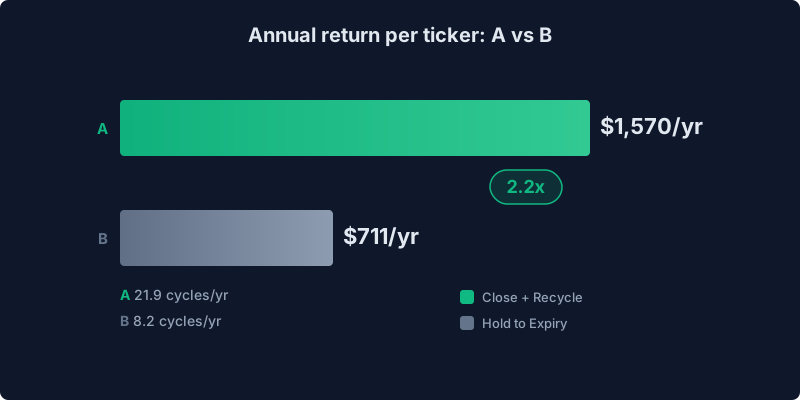
The "per trade" framing was the wrong unit of measurement. Options income is fundamentally a function of annualized return on buying power, not per-trade dollars. Once you ask the right question, the 50%-close rule isn't a conservative trade-off — it's actually the higher-return strategy.
Per-segment breakdown
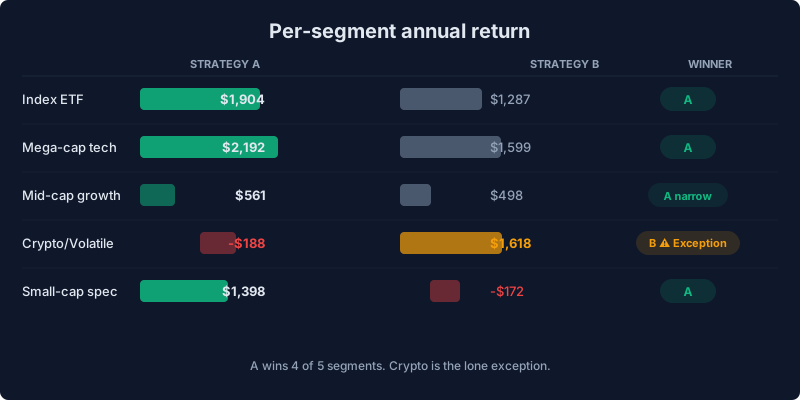
Strategy A wins in 4 out of 5 segments. The exception is Crypto/Volatile — and it's a striking exception. On MSTR/COIN/MARA, the per-trade premium is $283 (more than 2x any other segment). The volatility means hits to 50% take longer and reversals are more common, so the cycle advantage shrinks. The hold-to-expiry strategy, which captures the full premium when it works, dominates.
This is genuinely counterintuitive. Most options income guidance says "be more disciplined on volatile names — close at 50% and don't get greedy." The data says the opposite for the most volatile bucket: the per-trade premium is so rich that recycling more frequently reduces total return because you're giving up too much per-cycle EV.
The practical implication: on crypto-volatile names, let the position ride. On everything else, close fast and recycle.
Finding 2 — IV gating is the actual #1 strategy improvement
When I added the simple rule "skip the new trade if IVR < 25" on top of close+recycle (Strategy C), it beat both A and B:
| Metric | A (no gate) | C (IVR ≥ 25) | Improvement |
|---|---|---|---|
| Annual return | $1,570 | $2,131 | +$561 |
| Cycles per year | 21.9 | 19.8 | -2.1 |
| Win rate | 81.5% | 82.4% | +0.9pp |
| Sharpe | -0.00 | 0.27 | +0.27 |
| Avg max drawdown | $1,677 | $1,330 | $347 reduction (47% less) |
You're trading away 2 cycles per year in exchange for $561 more annual return, a meaningfully positive Sharpe, and a 47% reduction in drawdown. That's an obvious upgrade.
The IVR threshold matters. I tested cutoffs at 0, 25, 35, and 50:
| IVR cutoff | Cycles/Yr | Annual Return | Win Rate | Sharpe |
|---|---|---|---|---|
| 0 (no gate) | 21.9 | $1,570 | 81.5% | -0.00 |
| 25 | 19.8 | $2,131 | 82.4% | 0.27 |
| 35 | 17.4 | $1,833 | 86.4% | 0.21 |
| 50 | 11.7 | $1,050 | 86.4% | -1.15 |
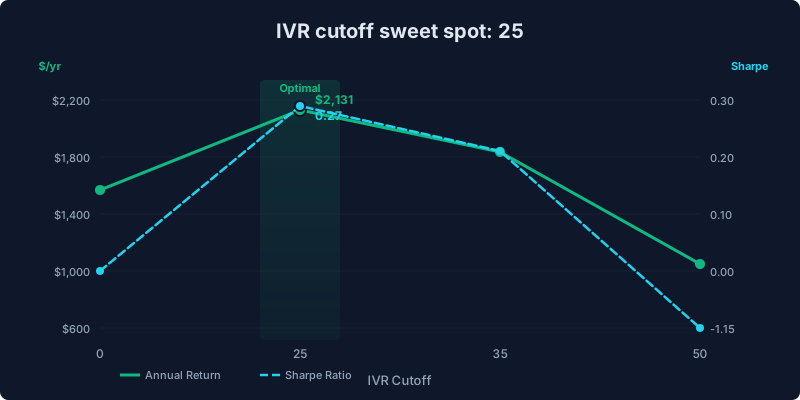
IVR cutoff of 25 maximizes Sharpe. Below 25 you're including too many low-EV cycles. Above 35 you're being too restrictive — you skip too many opportunities and the cycle advantage thins out.
For Index ETFs specifically, IV gating is transformative:
| Strategy on Index ETF | Annual return | Sharpe | Cycles/Yr |
|---|---|---|---|
| A (close + recycle) | $1,904 | 0.62 | 31.6 |
| C (close + recycle + IV gate) | $4,042 | 4.22 | 37.1 |
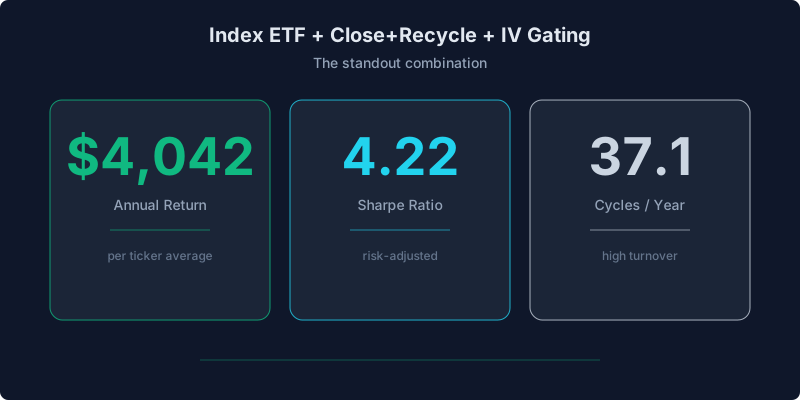
A Sharpe of 4.22 is exceptional. To put that in context: most professional volatility-selling strategies aim for Sharpe 1-2 over a full cycle. Index ETF + close + recycle + IV gating is a different class of result.
Practical takeaway. IVR < 25 = skip the cycle. The discipline of waiting is net positive. On Index ETFs specifically, this is where most of the strategy's edge actually comes from.
Finding 3 — DTE: 30-45 still wins, capital efficiency is the reason
The hit rate spread across DTE buckets is small:
| DTE bucket | Hit rate | Median days to 50% |
|---|---|---|
| 21-30 | 79.6% | 5 |
| 31-45 | 81.7% | 7 |
| 46-60 | 82.1% | 9 |
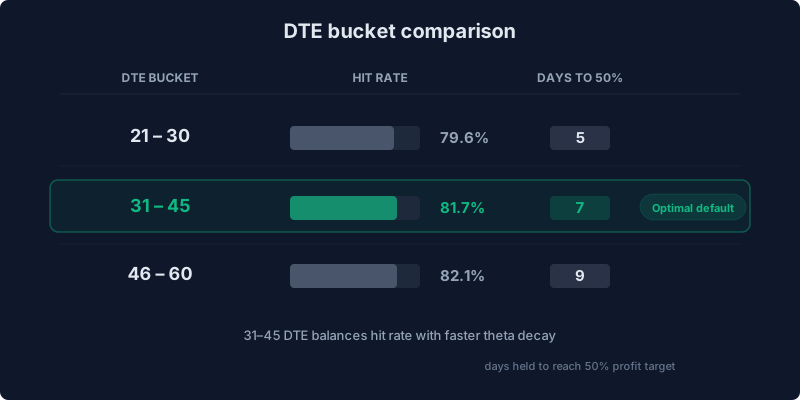
The win rate difference is only ~2.5pp. The real story is capital efficiency — and recycling makes this finding even stronger than the original analysis suggested. With Strategy A, shorter DTE means more cycles per year. The 30-45 DTE band is the sweet spot: capital cycles ~2x faster than 46-60, the win rate is essentially the same as 46-60, and the management buffer is reasonable.
Practical takeaway. 30-45 DTE remains the right default. Go shorter (21-30) only for specific event-driven setups. Go longer (46-60) only when premium is stretched and you specifically want longer capital binding.
Finding 4 — Realistic transaction costs erode A's advantage but don't reverse it
Mid-price fills are unrealistic. Let's see how the ranking holds under realistic execution.
Commission ($1.30 round-trip)
| Strategy | No commission | With commission | Impact |
|---|---|---|---|
| A | $1,570 | $1,542 | -$28 |
| B | $711 | $700 | -$11 |
Commission hurts A 2.7x more than B (because A has 2.7x more round-trips), but the absolute hit is small. Commissions are not the meaningful friction.
Spread cost (10% of credit)
| Strategy | Mid-price | With spread | Impact |
|---|---|---|---|
| A | $1,570 | $526 | -$1,044 |
| B | $711 | $304 | -$407 |
Spread cost is the dominant friction. The 10% credit haircut on every cycle adds up — on 21.9 cycles/year vs 8.2 cycles/year, A pays the spread tax much more often.
Combined realistic scenario (commission + 10% spread)
| Strategy | Idealized | Realistic | Erosion |
|---|---|---|---|
| A | $1,570 | $498 | 68% |
| B | $711 | $294 | 59% |
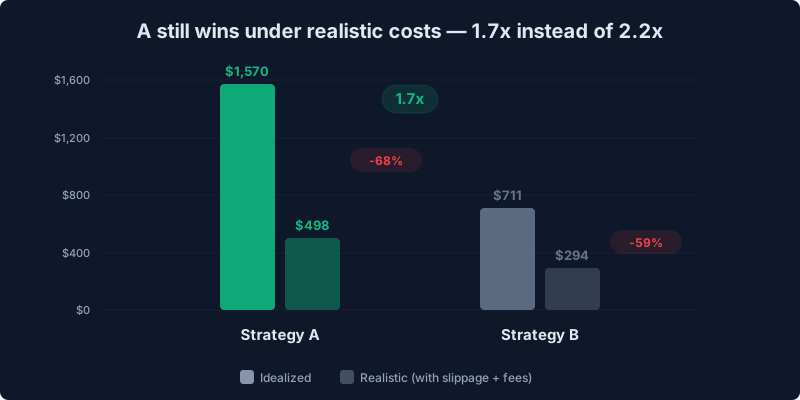
Strategy A still wins under realistic costs, but the margin shrinks from 2.2x to 1.7x. Strategy A loses more proportionally to costs (68% vs 59%) precisely because it cycles more often.
The implication: execution quality matters disproportionately for close-and-recycle strategies. If you can't shave fills below mid (limit orders, filling at mid or better), the strategy underperforms its ideal version more than hold-to-expiry does. For wheel operators on liquid index ETFs, this is fine. For traders working with thinner-spread crypto-volatile names, the spread tax compounds quickly.
Finding 5 — Cool-off period is fatal
If you can't open the next trade the moment the previous one closes — broker hold, T+1 settlement, watchlist constraints, low-IV market — Strategy A's advantage falls off a cliff.
| Cool-off period | Cycles/Yr | Annual return | Sharpe |
|---|---|---|---|
| 0 days | 21.9 | $1,570 | -0.00 |
| 1 day | 18.8 | $722 | -0.76 |
| 3 days | 16.2 | $960 | -1.01 |
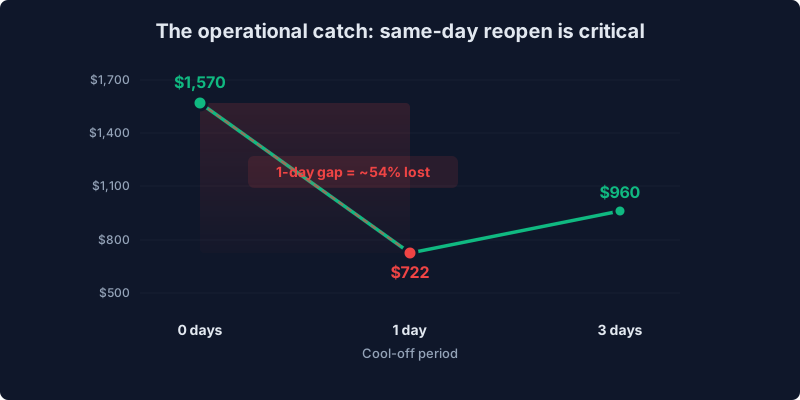
A single day of cool-off cuts the annual return roughly in half. Operational ability to recycle is critical. If your broker's cash settlement, your watchlist, or your market regime forces a 1-3 day gap between trades, the strategy returns most of its theoretical advantage.
This is the most important real-world caveat: the analysis assumes seamless recycling. In practice, recycling is friction-prone. Plan around T+1 settlement, keep a deep watchlist, and be ready to deploy capital across multiple tickers if your primary candidate isn't trade-ready.
Why per-trade was the wrong unit (and why "$116 more per trade" was misleading)
This is worth saying directly because the "per-trade" framing is deeply embedded in options-income content.
When the analysis says "hold earns $116 more per trade," it's comparing two events that happen on different timescales. The 50%-close trade resolves in 7 median days. The hold-to-expiry trade ties up the same capital for 33 median days. Comparing dollar profit per trade implicitly compares 7-day income to 33-day income on a one-to-one basis. That's not the right unit.
The right unit is annual return per dollar of buying power. On that unit:
- The 50%-close trade earns $51 over 7 days (~$2,660 annualized per dollar of BPR)
- The hold-to-expiry trade earns $114 over 33 days (~$1,260 annualized per dollar of BPR)
The 50%-close trade is more than 2x more efficient per dollar per unit time, even though it earns less per trade. That efficiency is what lets you run 2.7x more cycles. That's where the 2.2x annual return gap comes from.
This is also why the original "the 50% rule trades EV for risk management" framing is wrong. The 50% rule isn't trading EV for anything — it's the higher-EV choice once you compute EV correctly.
The cheatsheet
Decision framework distilled to what I actually use:
Step 1 — Always check IVR before opening. IVR < 25 → skip the cycle, wait for IV to recover. IVR 25-50 → trade with normal sizing. IVR > 50 → premium window, size up. IVR > 75 → very rich premium, size up further but with discipline.
Step 2 — Default strategy is close at 50% + recycle. Not because it's "conservative" — because it's the higher-annual-return strategy across 4 of 5 ticker segments.
Step 3 — Exception: crypto-volatile names (MSTR, COIN, MARA) — hold to expiry. The per-trade premium ($283) is rich enough that recycling more frequently reduces total return. This is the one place the standard "let winners run" advice is correct.
Step 4 — DTE: default 30-45. Go shorter only for specific event setups. Go longer when you want stretched capital binding.
Step 5 — Cool-off discipline matters. Have your watchlist deep. Be ready to redeploy capital across tickers when your primary candidate isn't ready. A single day's gap costs ~50% of the strategy's edge.
Step 6 — Execution quality matters. Use limit orders. Fill at mid or better when possible. Spread is the dominant cost; commission is rounding error. Don't chase the trade with market orders — let the spread come to you.
Step 7 — The standout combination is Index ETF + IV gating. Sharpe 4.22, $4,042/year per ticker. If you wheel SPY/QQQ at all, this is the configuration that produces the best risk-adjusted result in the dataset by a wide margin.
How to explore this yourself in OptionsLabPro
The findings above become more useful when you can feel them in your trade decisions, not just read them. Three tools in the platform map to the findings:
- Options Chain Simulator. Drag the IV slider to see how the entire premium structure reshapes across IVR regimes. The Strategy C IV-gating finding is visible in seconds — the difference between IVR 20 and IVR 75 premium pricing makes the gating discipline obvious.
- Probability & EV Calculator. Run 5,000-path Monte Carlo on the trades you're considering. Compare POP and EV across different DTE choices. Cross-check the "30-45 DTE is the sweet spot" finding on your own setup.
- Strategy Sandbox. Build the trade, set scenarios (earnings, crash, theta decay), and watch the payoff curve reprice live. Particularly useful for testing whether crypto-volatile names really do behave as the data suggests on a per-trade basis.
The full learning path walks through these decisions end-to-end: start with the basics, or jump to the Greeks and volatility if you're already selling premium and want to sharpen the decisions above.
Limitations
Six things to keep in mind before you trade off any of this:
-
Recycling proxy. I have terminal trade outcomes but not full daily P&L paths. The recycling simulation uses
days_to_50pctas the proxy for capital free-up timing. This is optimistic — actual intra-trade drawdowns or slow IV decay might prevent the clean cycle pattern. -
EOD mid-price fills. Real execution eats spread. The realistic-cost section above models this and shows A still wins, but the margin is meaningfully smaller (1.7x instead of 2.2x).
-
2020-2026 was favorable for premium sellers. No 2008-style sustained drawdown in the sample. Loss rates would widen in a real bear regime, and A's advantage might compress further.
-
No tax modeling. Closing more frequently generates more short-term capital gains events. For taxable accounts, this is a non-trivial drag on Strategy A's relative advantage. (Less relevant in IRAs, where most retail wheel operators run their book anyway.)
-
Account-level concentration not modeled. Each ticker is simulated independently. Real accounts have margin limits, concentration rules, and correlation. A $10,000 account can't actually run 28 simultaneous strategies.
-
No assignment path. Each trade is evaluated independently. Doesn't follow the CSP→assignment→CC wheel cycle. For wheel-cycle conclusions, you'd want a different analysis.
These limitations all tend to favor Strategy B (hold) over Strategy A (recycle), because recycling incurs more of each friction. If A wins in this idealized comparison, the margin of victory in practice will be smaller. If B wins, the real-world gap is likely larger.
Close
The 50%-close rule isn't conservative. It's optimal — once you measure on the right unit (annual return per dollar of buying power) and assume you can actually recycle the freed capital. The book recommended it as a default; the bigger dataset confirms it as a default but reframes why.
The two material updates from this re-analysis:
- Add IV gating (skip cycles when IVR < 25) — net positive across every metric I measured. Particularly transformative on Index ETFs, where it produces a Sharpe of 4.22.
- Make crypto-volatile names the exception — hold to expiry on MSTR/COIN/MARA. The per-trade premium is rich enough to dominate the cycle advantage. This contradicts the standard "be more disciplined on volatile names" advice and was the most surprising finding in the analysis.
The implementation reality matters more than the theory. Strategy A only delivers its theoretical advantage if you can recycle near-immediately and your fills are close to mid. A 1-day cool-off cuts the strategy's edge in half. Realistic spread cost trims it further. Plan execution accordingly.
As always, none of this is financial advice — it's what the data says about one premium-selling filter across one window of market conditions. Test it on your own history. Use the tools. Trust your own data before you trust anyone else's conclusions, including mine.
— Arda