

 Arda Zuber, PhD
You sold a put for $1.00. It is now worth $0.50. Buying it back means handing back half the premium you were hunting, and leaving the faster-decaying half to somebody else.
Do it anyway.
Easy money means safe, not fast
It is worth being precise here, because the intuitive version of this argument is backwards.
Time decay accelerates toward expiration. On a 45-day contract, theta alone erodes roughly 42% of the premium across the first 30 days — and the remaining 58% in the final 15.
Two thirds of the calendar time earns about half the money. The last third earns the other half.
So why close early?
Because of what you have to survive to collect it. Those final weeks are where gamma climbs — where a 2% move in the underlying stops nudging your position and starts throwing it. The second half of the premium decays faster and is earned in far more dangerous conditions.
That reframes the two phases:
Phase 1 — the safe money. Slower per day, but the position sits far from the strike and a bad session is an inconvenience. You are being paid modestly to carry very little.
Phase 2 — the dangerous money. Faster per day, and every day of it is spent inside the high-gamma stretch where the outcome is decided by what the stock does rather than by what time does.
In practice you usually reach 50% sooner than pure theta suggests, because the stock drifts away from your strike or the volatility you sold into contracts. Whenever it arrives, the question is the same: the remaining half can only be earned in phase 2.
What it looks like compounded
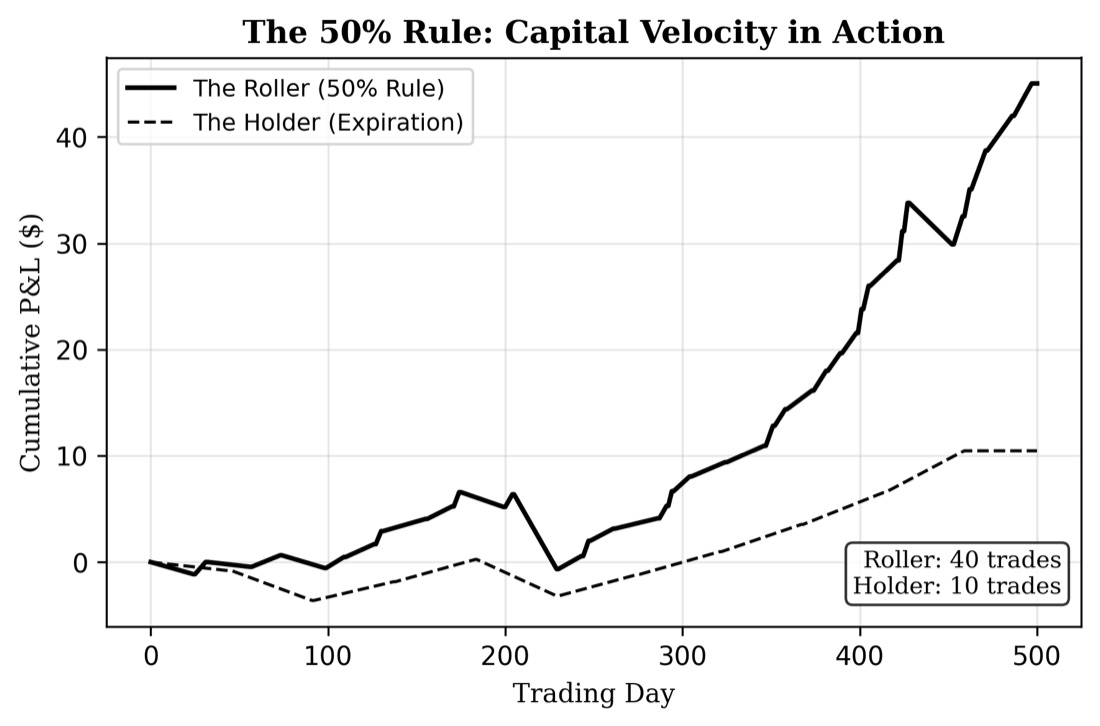
This is the part the per-trade view hides.
Over 500 trading days, the roller — closing at 50% and immediately opening a new 30-45 day position — runs roughly 40 trades. The holder waits for expiration every time and runs far fewer. The roller ends ahead, and the mechanism is not a higher win rate.
It is velocity. The same collateral does more cycles per year, and every new cycle restarts in phase 1 instead of grinding through phase 2.
Where this comes from
Question 18 of Wheel of Time Decay: Option Wheel Decoded — 72 questions on running the option wheel as a single repeating cycle.
“Of all the kindle unlimited books on the wheel strategy, and believe me when I say I have read almost all of them. This one is by far the best. Don’t overlook this gem!”— Amazon reader review, ★★★★★
Wheel of Time Decay on Amazon →
The second, quieter benefit
Closing early also removes you from the part of the option's life where surprises are most expensive.
Assignment risk, gap risk and gamma risk all concentrate in the final stretch. Exiting at 50% means you systematically skip it — not occasionally, but every cycle. Over a year that is a large number of expiration weeks you simply did not participate in.
You give up the last few cents of premium. You give up the tail with it.
Make it automatic
The rule fails in practice for a predictable reason: at the moment it triggers, the trade is going well, and a winning position is the hardest thing to close.
So do not leave it to judgment. The moment you sell the option, set a good-till-cancelled limit order to buy it back at half the credit. Sell for $1.00, immediately place a GTC buy at $0.50. Then close the platform.
The decision gets made once, while you are calm, and executes without you. That is the entire trick — the rule is not hard to understand, it is hard to obey in the moment, so you remove the moment.
The honest caveat
Fifty percent is a default, not a law. Wide bid-ask spreads can make closing expensive on illiquid chains — which is an argument for trading liquid chains, not for holding to expiration. And in unusually high volatility, some sellers take 60% or more.
The principle underneath survives the tuning: the first half of the premium is worth more than the second half, because it costs less risk to earn.
Keep reading
- Why 30-45 days is the entry window
- When to roll an option, and when not to
- Why a wide spread eats the profit
OptionsLabPro is a structured options course where the lessons are interactive — watch a theta curve pay out unevenly instead of reading that it does.