

 Arda Zuber, PhD
Ask which expiration to sell and you will get two confident answers. One camp says weeklies, because you can sell fifty-two of them a year. The other says forty-five days, because that is what everyone says.
Only one of them has the geometry of time decay behind it.
The spreadsheet argument for weeklies
The case is genuinely seductive, and it goes like this:
Why sell a 45-day put for $1.00 when I can sell a 7-day put for $0.30? Four weeks in a row is $1.20. That is more money.
The arithmetic is correct. It is also incomplete, and what it leaves out is the part that empties accounts.
Time decay is a curve, not a line
An option does not shed value evenly. The decay accelerates as expiration approaches, and the shape matters more than the total:
- 90 to 60 days — value moves very slowly. Stable, and slow to pay.
- 45 to 21 days — decay accelerates. This is the slope you want to be sitting on.
- 21 to 0 days — decay goes nearly vertical.
That last stretch looks like the best part. It is where the money falls out of the option fastest. It is also where the option becomes most sensitive to the underlying, and those two facts are the same fact.
Where this comes from
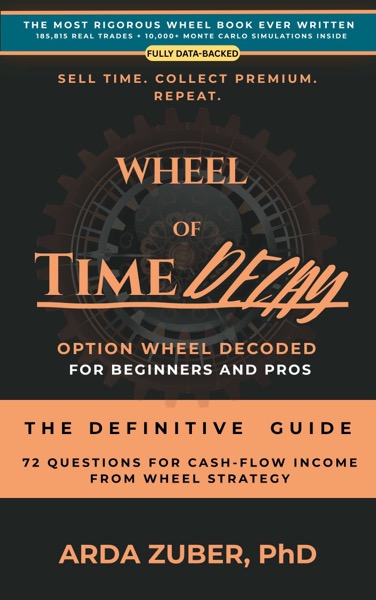
This is Question 15 of Wheel of Time Decay: Option Wheel Decoded — 72 questions working through the option wheel as a single repeating cycle, including the questions most treatments answer in a sentence.
“Of all the kindle unlimited books on the wheel strategy, and believe me when I say I have read almost all of them. This one is by far the best. Don’t overlook this gem!”— Amazon reader review, ★★★★★
Wheel of Time Decay on Amazon →
Why 90 days is too slow
Enter at 90 days and you lock up collateral for three months while collecting a premium that barely moves for the first thirty. Your return on capital per day is poor, and capital that is committed cannot be redeployed when a better setup appears.
The premium is bigger in absolute terms. It is worse per unit of time and per unit of capital, which is the measure that matters when the same collateral could run several cycles.
Why 7 days is dangerous
Gamma. Gamma measures how fast your delta changes when the stock moves, and it rises sharply as expiration approaches.
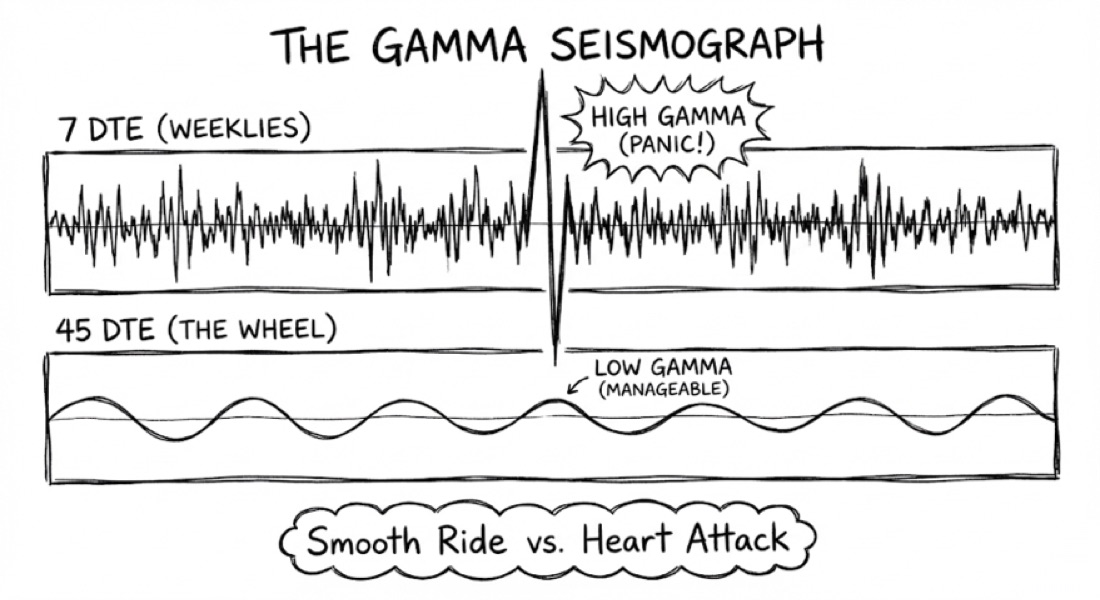
The picture is the argument. At 45 days a 2% move in the underlying nudges your position. At 7 days the same 2% move yanks it. Same strategy, same underlying, same premium collected — completely different experience of holding it.
And there is a cost the spreadsheet never shows: four weekly cycles mean four bid-ask spreads paid, four entry decisions made, and four separate chances to be assigned at an inconvenient moment. Friction is charged per transaction, not per dollar of premium.
The trap that closes behind you
Weeklies have a second failure mode that only appears once a trade goes against you.
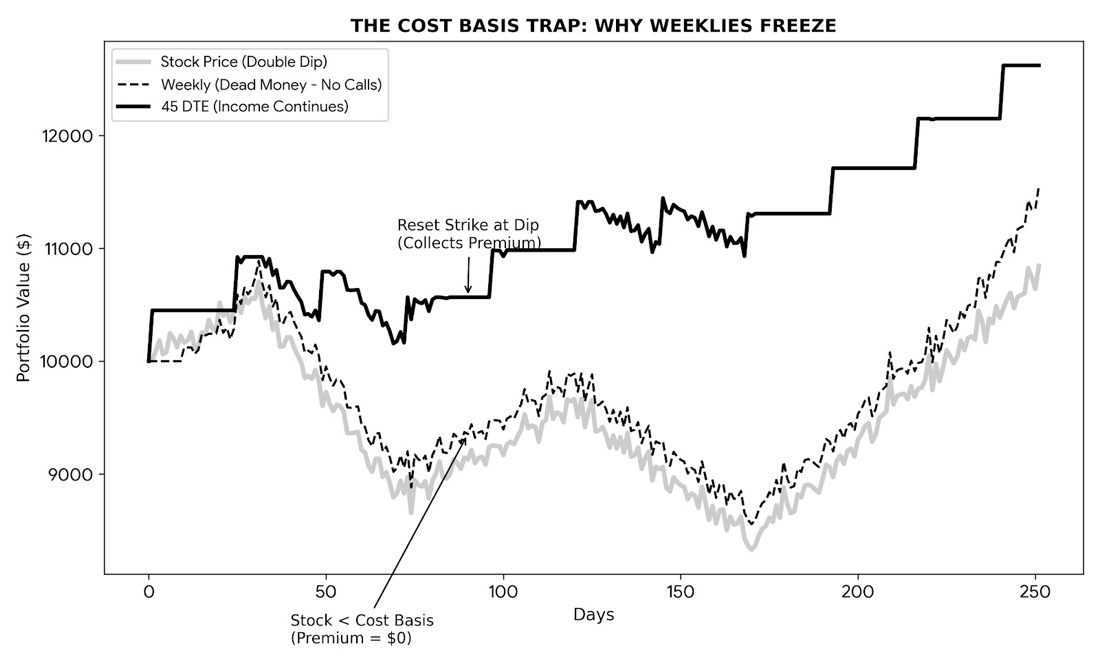
Once you have been assigned and the stock sits below your cost basis, you still need to sell calls to keep earning. At 7 days out, a strike at or above your cost basis pays essentially nothing — the option has almost no time value left to sell. The strategy does not blow up; it simply stops producing income at the exact moment you need it to produce income.
A 45-day call at the same strike still has time value in it. Distance from expiration is what you sell, and weeklies have almost none of it to give.
The window, stated plainly
Enter at 30 to 45 days. You arrive just before decay steepens and leave before it turns vertical — capturing the acceleration without sitting through the most gamma-sensitive stretch of the option's life.
It is not the most premium per contract. It is not the most premium per year on paper. It is the best trade-off between the money that decays toward you and the risk that moves against you, which is a different question and the one that actually determines whether you are still selling options next year.
Keep reading
- Closing at 50% and redeploying
- Sell puts on red days, not green days
- When to roll an option, and when not to
A theta curve on a page and a theta curve you can drag are different teachers. OptionsLabPro is a structured options course built around interactive lessons — change the days to expiration and watch the decay and the Greeks redraw.