

 Arda Zuber, PhD
Rolling is the most powerful move available to a premium seller and the one that does the most damage when it becomes a habit. The difference is not technique. It is timing and direction.
What a roll actually is
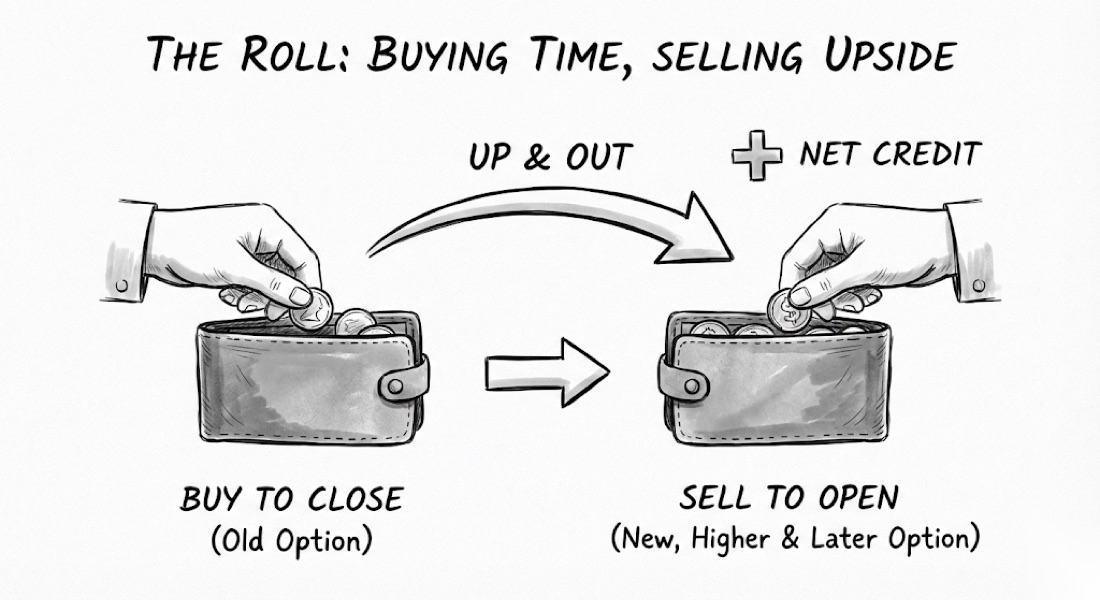
Two transactions, one order: buy to close the option you are short, sell to open a new one at a different strike and a later expiration.
That is all. Everything that matters is whether the pair nets to a credit or a debit, and whether the new strike is somewhere you actually want to be.
The timing rule
Roll while the trade is tested, not after it is buried.
The workable window is around 0.35 to 0.40 delta — the strike is being approached but the option still carries meaningful extrinsic value. Extrinsic value is the thing you are selling when you roll. It is what makes the new position pay more than closing the old one costs.
Once the option is deep in the money, that extrinsic value is gone. There is nothing left to sell, so the roll stops being an income decision and becomes a payment to postpone an outcome.
Most people roll too late for a simple reason: at 0.35 delta the trade is uncomfortable but survivable, so they wait. By the time it is unbearable, the manoeuvre that would have helped is no longer available.
Where this comes from
Questions 28 and 29 of Wheel of Time Decay: Option Wheel Decoded, which treat rolling up and rolling down as separate disciplines with separate failure modes.
“Of all the kindle unlimited books on the wheel strategy, and believe me when I say I have read almost all of them. This one is by far the best. Don’t overlook this gem!”— Amazon reader review, ★★★★★
Wheel of Time Decay on Amazon →
The credit rule
Only roll for a net credit.
A credit roll buys time and pays you for it. You extend the trade and your cost basis improves.
A debit roll spends real money today for a maybe. And notice what it usually means: the market is telling you there is no strike and no expiration you would accept where the numbers still work. That is information, not an obstacle to be paid around.
If the only available roll is a debit, the honest choices are to take assignment or take the loss. Both are cheaper than a sequence of debit rolls, which is how a manageable loss becomes an unmanageable one — each individual step small, each defensible, the total ruinous.
Rolling up: capturing more upside
When a stock rallies past your covered call, rolling up and out — higher strike, later expiration — lets you participate in more of the move.
But start from the fact that you have already won. You kept the premium and captured the gain to your strike. Rolling up is optional, and it is a fresh directional decision on a stock that is now more expensive than when you first judged it attractive.
Do it when the thesis genuinely improved. Not because the green candle makes the cap feel like theft.
Rolling down: the floor that does not move
Rolling down and out is the most misunderstood move on the wheel, and it has one hard limit.
Never roll a covered call below your adjusted cost basis.
The temptation is mechanical. Your $50 call is worth $0.10, the stock sits at $45, and a $45 call next month pays $1.50. Free money.
It is not free. If you are called away at $45 on shares that effectively cost you $48, you have signed a guaranteed loss in exchange for $1.50. You did not collect premium — you sold your own recovery, and cheaply.
The rule that survives: close the far-out-of-the-money call once it has lost 80% or more of its value, then sell a new call at a lower strike that is still at or above your adjusted cost basis, with a later expiration to make the premium worth collecting. If no such strike pays anything, that is the answer. Wait.
The pattern underneath
Every rule here is the same rule wearing different clothes: roll while you still have choices.
A tested position has options. A buried one has only bills. The skill is acting during the window when the manoeuvre is still cheap — which is exactly the window in which it does not yet feel urgent.
Keep reading
- Why assignment is not a loss
- What to do when the stock gaps past your strike
- Closing at 50% and redeploying
OptionsLabPro is a structured options course where the lessons are interactive — roll a position and watch the payoff curve move before you do it with money.