

 Arda Zuber, PhD
The stock missed earnings. The CEO left to pursue other interests. It gapped from $52 to $40, and your $50 put is now ten dollars in the money.
Your broker will offer you an escape that is not one.
The roll that goes nowhere
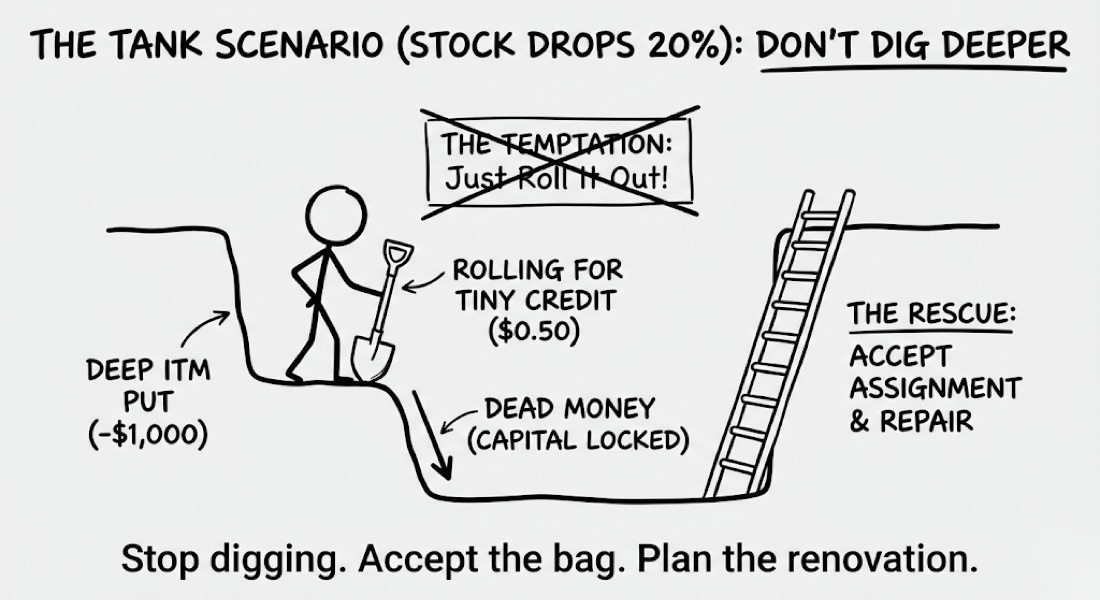
Run the numbers on the roll, because they look better in the abstract than on paper.
Your $50 put costs about $10.00 to buy back. A $50 put ninety days out sells for about $10.50. Net credit: $0.50 per contract.
For that fifty cents you have committed your collateral for another three months. And ninety days later, if the stock is at $42, you do it again — buy at $8.00, sell at $8.50, another $0.50. Another quarter gone.
Two rolls, six months, a dollar per contract, and the position has not improved in any way. That is the digging in the picture: motion that feels like management and changes nothing except how long your money is stuck.
The reason the roll pays so little is structural. A deep in-the-money put is nearly all intrinsic value, and intrinsic value is not for sale. The only thing a roll can monetise is extrinsic value, and there is barely any left.
Take the assignment
The move that feels like surrender is the one that restores your options.
Accept assignment. You own 1,000 shares at $50 while the market says $40 — the loss you had already taken on paper, now simply visible in a different row. But the position has changed character entirely:
- You can sell covered calls against the shares and start grinding the cost basis down
- You collect dividends if the company pays them
- Your capital is working rather than pledged against a frozen contract
Assignment converts a dead position into a live one. Every premium after that point moves your break-even in the right direction, which is more than any roll accomplished.
Where this comes from
Question 53 of Wheel of Time Decay: Option Wheel Decoded, part of a set of scenario walkthroughs — the boring win, the challenger, the tank and the rocket.
“Of all the kindle unlimited books on the wheel strategy, and believe me when I say I have read almost all of them. This one is by far the best. Don’t overlook this gem!”— Amazon reader review, ★★★★★
Wheel of Time Decay on Amazon →
First, answer the only question that matters
Before repairing anything, decide whether this is a company you still want.
Is the thesis intact? Was the drop a bad quarter on a business that is otherwise fine — or did something structural break? Fraud, a dividend cut, a collapsing moat, a balance sheet that stopped working.
If the thesis broke, none of the machinery applies. Selling calls on a dying company is not a repair, it is a slower exit with extra steps. Take the loss and move the capital somewhere it can work.
If the thesis holds, you own a good business at a bad price, and the wheel is built precisely for that.
Why people roll anyway
Because assignment makes the loss feel real, and rolling keeps it unrealised.
That is the entire psychology, and it is expensive. The loss is identical either way — it is already in your account, marked to market, whether or not you have shares to show for it. Rolling does not reduce it. It just keeps the number in a column that feels less final while your capital sits idle.
The caption on that drawing puts it better than I can: stop digging, accept the bag, plan the renovation.
Keep reading
- Why assignment is not a loss
- Why percentage stop-losses break the wheel
- When to roll an option, and when not to
OptionsLabPro is a structured options course built on interactive lessons — see what a deep ITM position does to a payoff curve before you are holding one.