

 Arda Zuber, PhD
Every trading education starts with the same instruction: cut your losses. Set a stop. Never let a small loss become a large one.
On the wheel, that advice will take a strategy that was working and end it — at the worst possible moment, on purpose, by rule.
Why a percentage stop breaks the machine
The wheel is contrarian by construction. Every part of it assumes decline:
- You sell puts at strikes below the price, expecting dips
- You take assignment when price falls through them
- You sell calls afterwards to grind the cost basis down
Now add a rule that exits at −10%. It fires exactly when the mechanism engages. You realise a drawdown you had been paid to accept, and you shut off the income stream that existed to repair it.
A swing trader's stop protects a directional bet. The wheel is not a directional bet. Importing the tool imports the wrong assumption.
Price is not the question
The useful question is not how far has it fallen but is this still the stock I thought I was buying.
A 20% drawdown on a quality business usually rebounds. A 60% drawdown on a decaying one usually does not. Same-looking red, opposite meanings — and the difference is visible in the filings, not on the chart.
Where this comes from
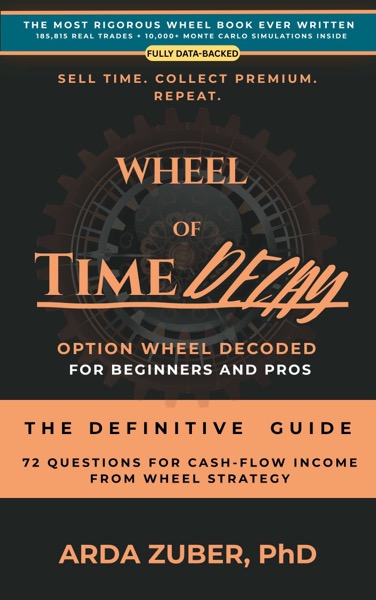
Question 48 of Wheel of Time Decay: Option Wheel Decoded, whose third section is entirely about the risk side — stock selection, sizing, correlation, and when to walk away.
“Of all the kindle unlimited books on the wheel strategy, and believe me when I say I have read almost all of them. This one is by far the best. Don’t overlook this gem!”— Amazon reader review, ★★★★★
Wheel of Time Decay on Amazon →
The four triggers that do qualify
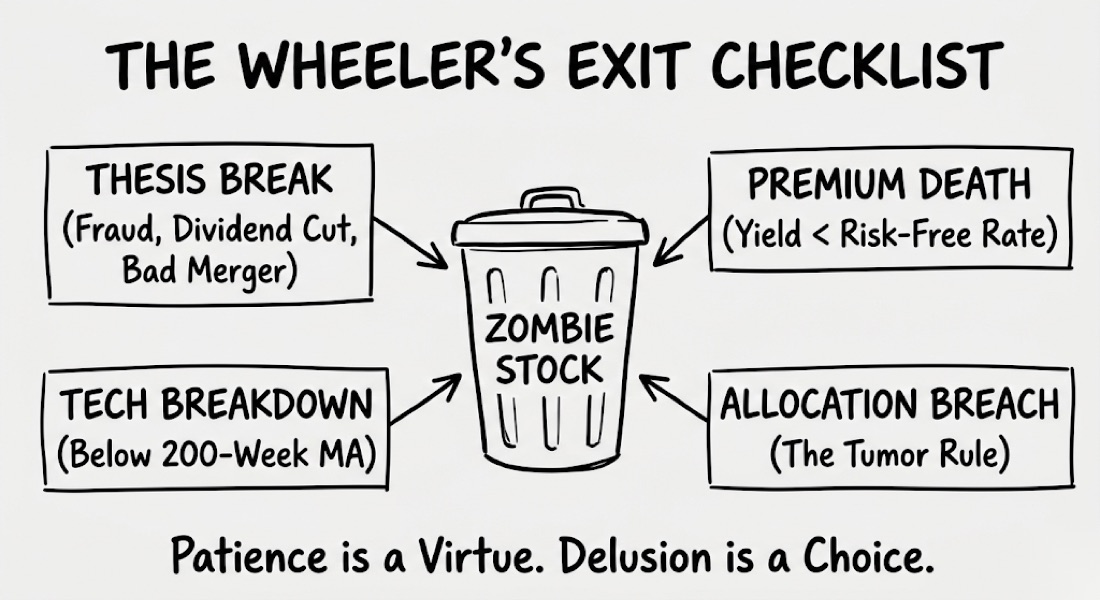
1. Thesis break. The facts you bought on changed. Fraud or accounting irregularities — an SEC investigation, a CFO resignation, a restatement. A dividend cut when yield was the reason you were there. An acquisition that changes the risk profile you signed up for. A moat that is visibly eroding. In each case the contract is broken. Sell, take the loss, and stop trying to make it back on a vehicle that no longer works.
2. Premium death. The option yield has fallen below what cash earns risk-free. You are now carrying equity risk for less than a Treasury pays. Nothing dramatic happened; the trade simply stopped being a trade.
3. Technical breakdown. Not a daily candle — the 200-week moving average. That is a decade-scale trend line, and losing it is a different signal from a bad quarter.
4. Allocation breach. The position has grown, or your account has shrunk, and it now exceeds its size limit. Fire it for arithmetic reasons even if you still like the company.
The line worth keeping
The caption on that checklist does the work: patience is a virtue, delusion is a choice.
The wheel demands the first and punishes the second, and the entire skill is knowing which one you are currently exercising. A stop-loss cannot tell them apart — it only measures distance from your entry, which is a fact about you, not about the company.
Thesis triggers can tell them apart, which is why they are the exit rule.
Keep reading
- What to do when the stock gaps past your strike
- Why assignment is not a loss
- When to stop selling and hold cash
OptionsLabPro is a structured options course built on interactive lessons rather than rules to memorise.