

 Arda Zuber, PhD
There is one instruction in trading that everybody agrees with and almost nobody follows: sometimes the correct action is none.
It is hard because inaction reads as failure. Not trading feels like leaving money on the table, and the premium is right there, quoted, available. But the wheel is a fair-weather strategy — it does well in three market regimes and badly in the fourth, and knowing which one you are in is worth more than any strike selection.
Where the wheel actually works
Bull markets, modestly up. Puts expire worthless, shares get called away at a profit, the cycle repeats. This is its natural habitat.
Flat markets. Time decay does all the work with no directional risk. Pure income.
Corrections. Assignment happens, you sell calls, the cost basis grinds down, the market recovers. Uncomfortable and entirely survivable.
Crashes. This is the one it is not built for. Prices gap instead of drifting, correlations converge so every position moves together, margin requirements expand, and the recovery the strategy waits for may outlast the account's ability to wait.
The three red flags
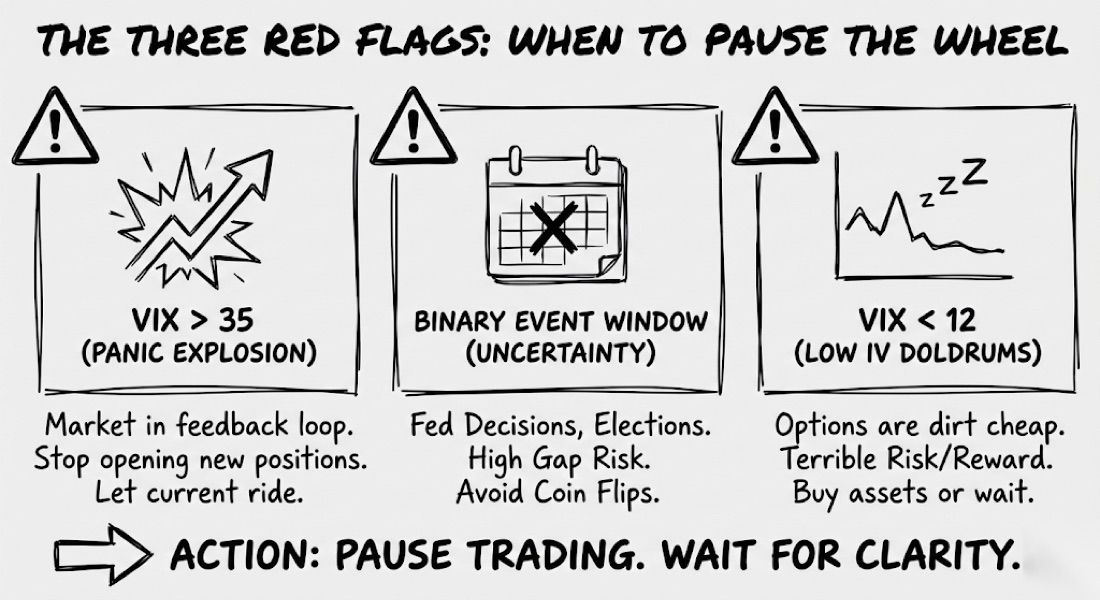
VIX above 35 — panic. The market is in a feedback loop where selling causes selling. Stop opening new positions and let the existing ones run. The premiums look extraordinary, which is the trap: they are pricing an environment where your usual assumptions do not hold.
A binary event window. Fed decisions, elections, major rulings. Gap risk is elevated for reasons no premium prices fairly, and you are being asked to take a coin flip disguised as an income trade.
VIX below 12 — the doldrums. The opposite failure. Options are dirt cheap, the risk-reward is terrible, and you would be locking up collateral and carrying assignment risk for a credit that does not compensate for either. Buy assets or wait.
Two of these say too dangerous. One says not worth it. All three say the same thing: do not trade.
Where this comes from
Question 70 of Wheel of Time Decay: Option Wheel Decoded, in the final section on systems and psychology — the weekend routine, the journal, FOMO, panic, and when to stop.
“Of all the kindle unlimited books on the wheel strategy, and believe me when I say I have read almost all of them. This one is by far the best. Don’t overlook this gem!”— Amazon reader review, ★★★★★
Wheel of Time Decay on Amazon →
Cash is not idleness
The reframe that makes this bearable: cash is a position, and it is the only one that gains value as everything else loses it.
When quality companies are marked down 30%, the trader holding cash can act. The fully deployed trader can only watch — and worse, is usually being liquidated into that same decline, which is how you end up selling at the bottom to someone who kept powder dry.
The premium you failed to collect during a crisis is a small number. The position you could not take at the bottom is a large one, and it does not show up anywhere as a loss.
The measure that matters
The book's line is the one worth keeping: the difference between an amateur and a professional is not how many trades they make — it is how many they don't.
A month with no new positions is not a wasted month if the alternative was three trades into a feedback loop. It just does not feel that way at the time, which is exactly why it needs to be a rule rather than a judgement call made while looking at a screen full of rich premiums.
Keep reading
OptionsLabPro is a structured options course built on interactive lessons.