

 Arda Zuber, PhD
The most expensive mistake in premium selling does not look like a mistake. It looks like an opportunity, it appeals to the part of your brain that likes arithmetic, and it usually arrives with a screenshot of an annualised return.
You find a stock paying 15% a month. You do the multiplication. And you sell the put.
Premium is not profit — it is compensation
The mental correction that has to happen first: premium is the price of risk, not a reward for skill.
When a stock offers you three times your usual premium, the market is not failing to notice something you spotted. It is telling you what it expects. Options are priced off expected move — if the market is handing you a 15% premium, a 15% move is roughly what it has priced in.
So run the case honestly. A $10 stock, $1.50 collected:
- Stock holds at $10 — you keep $1.50. Excellent cycle.
- Stock falls to $5 — you keep $1.50 and lose $5.00 per share on the assignment. Net −$3.50 per share, about 35% of your capital.
One outcome of the two is not a tail event on a name priced at 100% IV. It is the scenario the pricing was describing.
The two cliffs
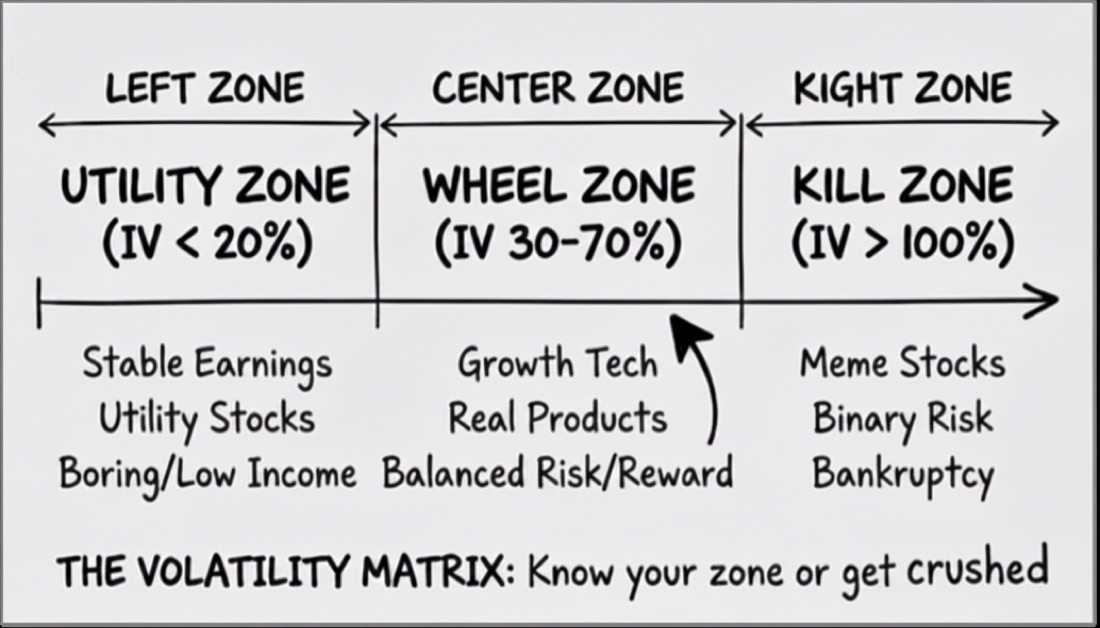
There are two ways to be wrong about implied volatility and they sit at opposite ends.
Too quiet. Below roughly 20-30% IV, the premium does not justify the collateral. You lock up thousands of dollars for a return that a savings account competes with, and you carry assignment risk for the privilege.
Too loud. Above roughly 100%, you are not trading a stock, you are underwriting a crisis. The premium is real. So is what it is paying for.
The workable band is in between — enough compensation to be worth the capital, not so much that the number itself is the warning.
Where this comes from
This is Question 41 of Wheel of Time Decay: Option Wheel Decoded, which spends its third section on the risk side of the wheel — stock selection, sizing, correlation, and the failure modes that only show up in the years the median does not describe.
“Of all the kindle unlimited books on the wheel strategy, and believe me when I say I have read almost all of them. This one is by far the best. Don’t overlook this gem!”— Amazon reader review, ★★★★★
Wheel of Time Decay on Amazon →
The picture the book draws literally
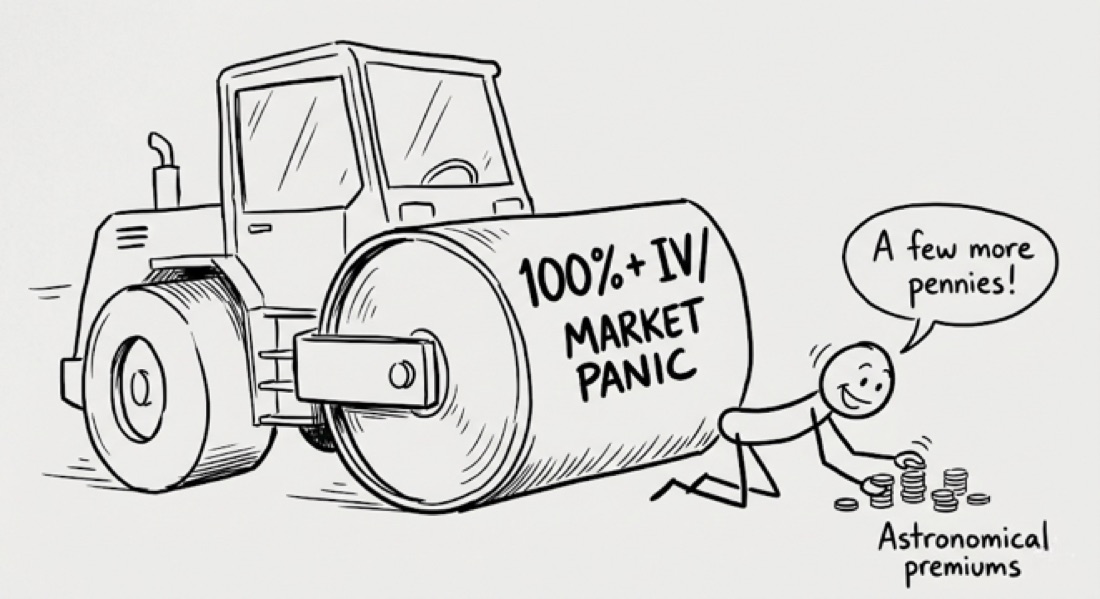
The old line about picking up pennies in front of a steamroller gets used loosely. Here it is exact.
The pennies are genuinely there: a name at 100% IV really does pay five to ten times normal premium, and in most months you really do collect it. The steamroller is also genuinely there, and the reason people keep walking into it is that it moves more slowly than they assume. You collect for six months. The seventh pays for all of it.
Why the median misleads
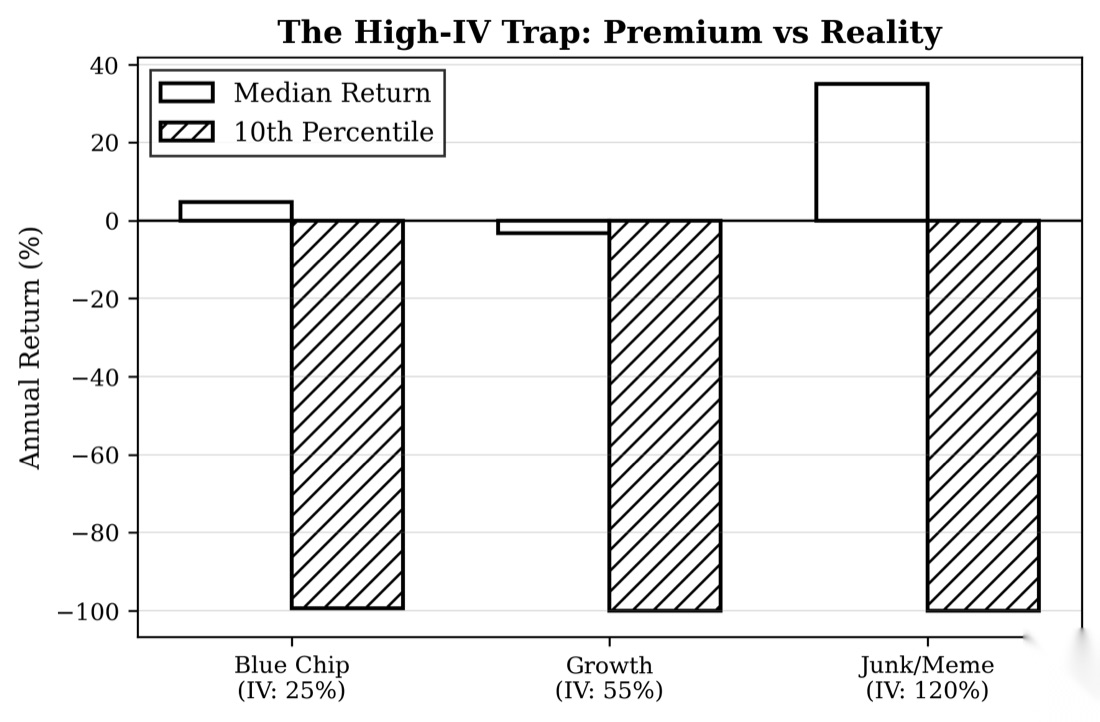
This is the chart worth sitting with, because it concedes the other side of the argument.
In a typical year, the high-IV names win on median return. The premium math is real. That is precisely why the strategy survives long enough to become a habit — most of the time it pays, and every payment is evidence that you were right.
The difference is in the tail. The distribution of outcomes on a distressed name is not a slightly wider version of the distribution on a quality name; it has a much deeper left side. Median return is what you experience most years. The tail is what determines whether you are still trading after several of them.
Quality and volatility are inversely related for a reason
The relationship is mechanical, not coincidental.
Quality is shorthand for survivability: positive operating cash flow across several years, a defensible competitive position, debt that is manageable against earnings. Businesses with those traits produce narrow, predictable outcome distributions — and narrow distributions price at 20-30% IV. Apple and Microsoft pay boring premiums because they are boring companies to forecast.
Low quality means the opposite: no earnings, heavy debt, hype-driven or in survival mode. Wide distribution, 100%+ IV, premiums that feel exciting at 10-15% a month.
The premium is the market quoting you the width of the distribution. You are not finding value; you are reading a measurement.
The question that settles it
The wheel rests on a single prerequisite: you must be genuinely willing to own the stock, because the strategy's failure mode is owning it.
So ask it directly. Can you happily hold a company at 120% IV for five years?
Almost certainly not — and a company at 120% IV may not be there in five years to hold. If the answer is no, the premium is irrelevant, because the assignment is not a hypothetical inconvenience. It is the outcome the pricing was describing all along.
Keep reading
- High premium is hazard pay
- Fat tails and the moves models call impossible
- Matching size to the volatility regime
Reading that high IV widens the distribution is one thing; moving an IV slider and watching the payoff curve stretch is another. OptionsLabPro is a structured options course where the lessons are interactive.