

 Arda Zuber, PhD
Every premium seller meets the same moment. You are scanning for candidates and one strike pays three times what everything else pays. The annualised number is absurd. Nothing in the chart looks broken.
The instinct is that you found something. You did not. You were quoted something.
What a rich premium actually says
Option prices come from expected move. A large premium is the market stating, in the only language it has, that it expects a large move.
So there is a question that separates the two readings, and it is not a difficult one:
The beginner sees a high premium and thinks easy money. The professional sees a high premium and asks what do they know that I don't?
The answer is nearly always a date. Earnings. A court ruling. A regulatory decision. A drug trial. A refinancing. Something the market has looked up and priced, and you have not.
The arithmetic, on a real shape of trade
Take Apple at $190, three days before earnings.
The trap. The $180 put is paying $2.40. That is a strike 5% out of the money on a company nobody thinks is going bankrupt. It looks like income.
The pricing. The market is implying a move of about ±$9.50. Your strike is $10 away. You are not 5% out of the money in any meaningful sense — you are barely outside the expected move.
The outcome that is not rare. Earnings miss, the stock gaps to $167. That is −12%, which happens to good companies several times a decade. Your put is now worth $13.00.
You collected $240 and you are down $1,060 per contract.
Nothing went wrong. The distribution did what the price said it would.
Where this comes from
Wisdom 3 of Live to Sell Another Day: The Seller's Code — twenty-five rules distilled from real losses, organised around risk rather than around a catalogue of strategies.
Live to Sell Another Day on Amazon →
The premium rises linearly, the risk does not
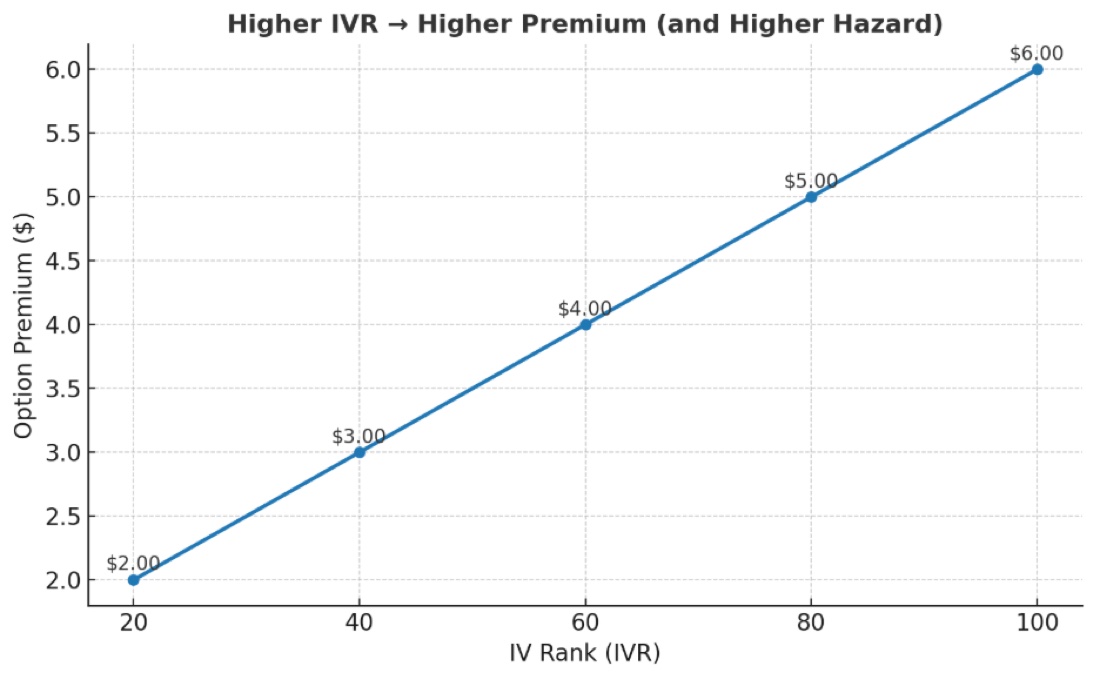
This is the part that makes the trade seductive rather than obviously bad.
As IV Rank climbs from 20 to 100, the premium rises in a straight line — $2.00, $3.00, $4.00, $5.00, $6.00. Tripling your credit for tripling the IV rank feels like a fair, proportionate deal.
It is not, because the other side of the trade does not move in a straight line. Premium rises linearly; the probability of a large gap rises much faster. The compensation is arithmetic while the risk is closer to exponential, and the gap between those two curves is where accounts are lost.
You are being paid more. You are not being paid enough.
What to do instead of avoiding it
High IV is where premium sellers make their money, so "never sell into it" is the wrong lesson. The correct one is that the structure has to change with the regime.
- Cap the risk. When the credit is unusually rich, sell a defined-risk spread rather than a naked put. You give up some credit and buy a known maximum loss.
- Cut the size. The same dollar exposure is not the same risk when the distribution widens. If you would normally sell three contracts, sell one.
- Know the catalyst. If you cannot name why the premium is high, you have not finished your analysis. "The scanner found it" is not an answer.
The mental correction
Stop reading a high premium as a discovery. Read it as a quotation.
The market is telling you the price of the risk it sees. Your job is not to feel clever about the number — it is to decide whether you want to underwrite the event behind it, at the size you were about to use.
Most of the time, the honest answer is not at that size.
Keep reading
- Why 100% IV is a trap
- Fat tails and the moves models call impossible
- Matching size to the volatility regime
OptionsLabPro is a structured options course built on interactive lessons — move an IV slider and watch the premium and the distribution change together.