

 Arda Zuber, PhD
Most traders pick a position size once, early, and then keep it. It becomes part of the routine — two contracts, or 2% of the account, whatever the number is.
The market does not hold still, and a constant size in a changing environment is not consistency. It is a slowly drifting risk level.
Two personalities
The book's framing is the useful one: the market has a Dr. Jekyll and a Mr. Hyde.
Low volatility. Prices drift. Mean reversion is slow but reliable. Buying dips works.
High volatility. Prices gap rather than drift. Correlations converge. Margin requirements expand. Buying dips gets you liquidated.
These are not the same market with different numbers. They reward different behaviour, and most blow-ups come from running a strategy that suits one of them into the other — usually the one it was learned in.
The sizing rule is a staircase
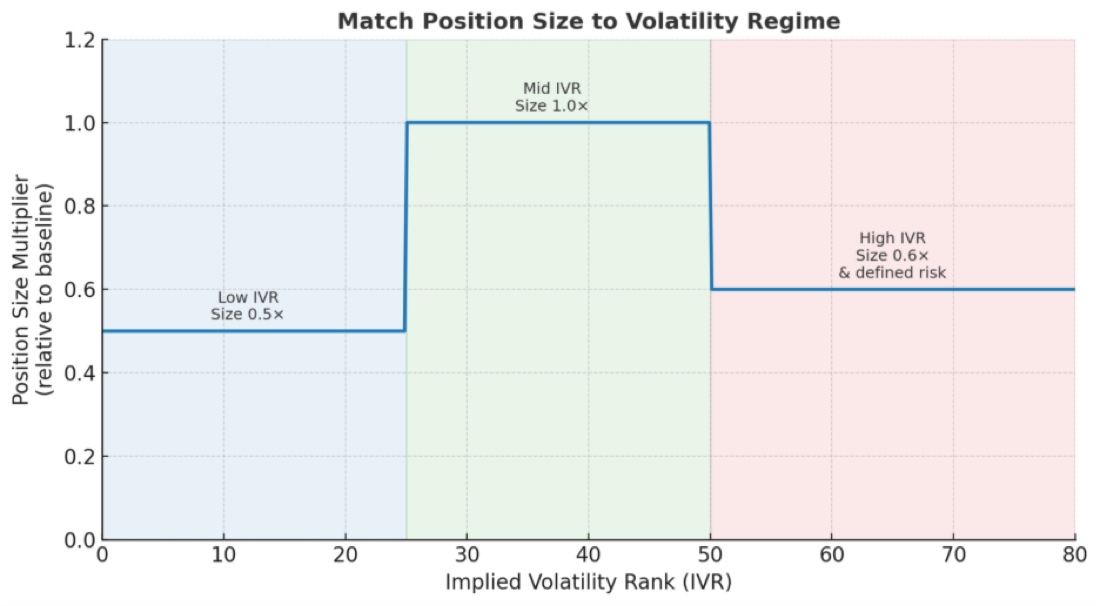
Notice that this is not a downward slope. It is a hump, and the shape is the point.
Low IVR (below ~25) — half size. Not because it is dangerous, but because it pays badly. Premiums are thin, so you would be locking up collateral and carrying assignment risk for a credit that does not justify either. Cheap premium is not cheap risk; it is the same risk at a discount to you.
Mid IVR (~25-50) — full size. The working zone. Enough premium to be worth the capital, not so much that the number is a warning. Strangles, iron condors, cash-secured puts all behave the way the textbook says here.
High IVR (above ~50) — 0.6x or less, and define the risk. The reason is mechanical: in a crisis regime, a 1% move hurts roughly three times as much through gamma and vega expansion. Same underlying, same nominal position, triple the pain per unit of movement.
Where this comes from
Wisdom 18 of Live to Sell Another Day: The Seller's Code — twenty-five rules distilled from real losses, organised around risk rather than a catalogue of strategies.
Live to Sell Another Day on Amazon →
Why it must be mechanical
The obvious objection is that high IVR is when premium sellers get paid, so cutting size there means leaving money on the table.
True. It also means being present for the following month.
The deeper reason to make it a rule rather than a judgement: the regime that most demands smaller size is the one that most tempts you to size up. Rich premiums appear exactly when the distribution has widened. If sizing is a decision you make in the moment, you will make it while looking at the biggest credit you have seen all year.
A step function does not have that problem. You look up the IVR, you read the multiplier, you place the trade.
The structure changes, not just the number
Above the crisis threshold, cutting size is only half the adjustment. Switch from naked short premium to defined risk.
In a calm market an undefined-risk position is uncomfortable in the tail. In a crisis regime it is a different instrument — correlations have converged so your positions move together, margin has expanded so your capacity has shrunk, and gaps mean the price you get is not the price you saw.
A vertical spread caps the loss at a number you chose. That certainty is worth more when the distribution is wide than when it is narrow, which is precisely when most people abandon it in search of the full credit.
The one-line version
You cannot drive 100 mph in the rain just because that is what you drive on a dry road.
Keep reading
OptionsLabPro is a structured options course built on interactive lessons.