

 Arda Zuber, PhD
You sold a cash-secured put. The stock closed below your strike. On Saturday your collateral turned into 100 shares, and on Monday your platform greeted you with a red number.
Most people read that number as a verdict. It is not. It is an answer to a narrower question than the one you were asking.
What assignment actually is
Assignment is a swap, not an event that happens to you. The cash your broker had locked is exchanged for 100 shares at the strike you chose, at the price you agreed to weeks earlier, on a stock you had already decided you were willing to own.
That last clause is the whole strategy. If it is not true, the problem started at entry and assignment merely revealed it.
The number your screen is showing you
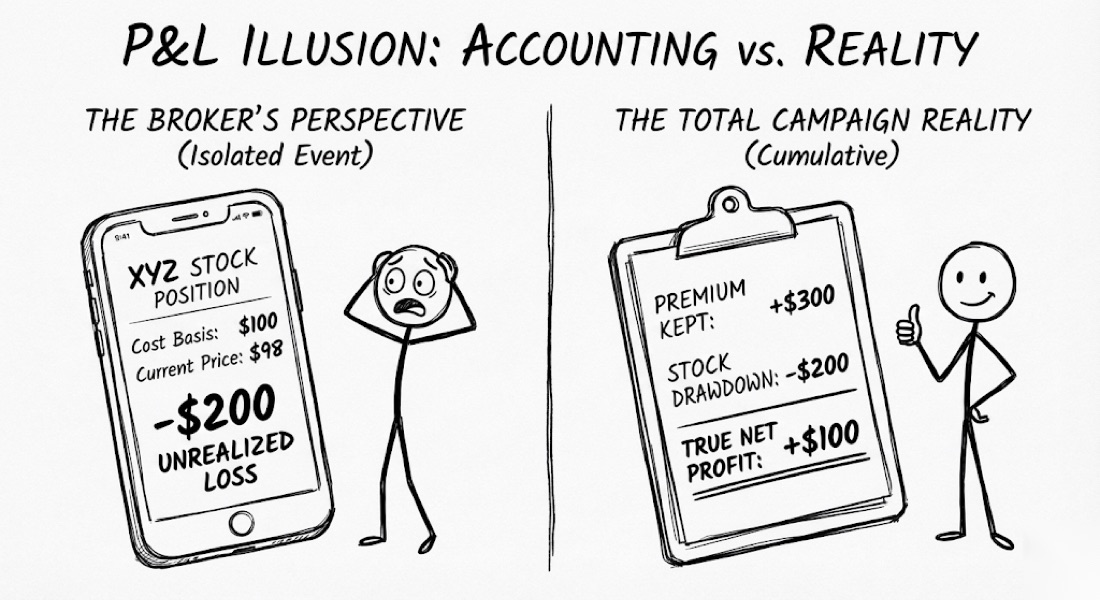
Here is the same trade seen two ways.
The broker's view. Cost basis $100, current price $98, unrealized loss $200. Red, alarming, and arithmetically correct.
The campaign's view. Premium collected across the cycle: +$300. Stock drawdown: −$200. Net: +$100.
Both are true. Only one of them describes your trade.
Your platform books the stock at market against the strike and files the premium as a separate closed event that happened weeks ago. It is not lying — it is measuring one leg of a three-leg structure, because that is what a position ledger does.
Where this comes from
Questions 20 and 23 of Wheel of Time Decay: Option Wheel Decoded, which works through the option wheel as one repeating cycle across 72 questions.
“Of all the kindle unlimited books on the wheel strategy, and believe me when I say I have read almost all of them. This one is by far the best. Don’t overlook this gem!”— Amazon reader review, ★★★★★
Wheel of Time Decay on Amazon →
Why this matters more than it sounds
The confusion is not academic, because red numbers drive behaviour.
A wheeler who reads assignment as failure does the two things that actually cause damage: they sell the shares immediately to "stop the loss," realising a drawdown they had been paid to accept, and they stop selling calls on the position — abandoning the income that was supposed to reduce the cost basis in the first place.
The cycle is designed to be entered at assignment. Reading the middle of the strategy as the failure of the strategy is how people quit at exactly the wrong moment.
The number that does tell the truth
Track adjusted cost basis, not the platform's unrealized P&L.
Every premium you collect — the original put, and every call you sell afterwards — comes off your effective purchase price. A $100 strike with $3.00 of premium collected is a $97 cost basis, and each subsequent call lowers it further.
That figure moves in the direction your work moves. The platform's number moves with the stock, which is the thing you cannot control.
The one case where it really is a loss
Assignment on a company whose thesis has broken is a loss, and no amount of accounting reframes it. If the earnings collapsed, the sector inverted, or the balance sheet stopped being survivable, you own something you no longer want at a price you no longer like.
But notice that the failure is not the assignment. It is the entry — a put sold on a stock that did not belong in the wheel. Assignment simply delivered the consequence.
Keep reading
- Having your shares called away is the win
- FIFO versus Specific ID for tax lots
- What to do when the stock gaps past your strike
OptionsLabPro is a structured options course where the lessons are interactive — build the position, move the stock, and watch what assignment does to the payoff curve before it happens to your account.