

 Arda Zuber, PhD
Your stock ran, blew through your covered call strike, and on expiration your shares were gone at a price the market has already left behind. The position closed at maximum profit — and it feels like you were robbed.
That feeling is the most expensive thing in premium selling, because it is the one that makes people change a strategy that just worked.
What actually happened
Three things, all of them good:
- You kept the entire premium. It was yours the day you sold the call.
- You captured the capital gain you planned for — from your cost basis up to the strike you chose.
- Your collateral is unlocked and can go to work again on Monday.
A covered call has a ceiling by construction. You agreed to that ceiling in exchange for being paid up front. Hitting it is not the strategy breaking; it is the strategy completing.
Why it stings anyway
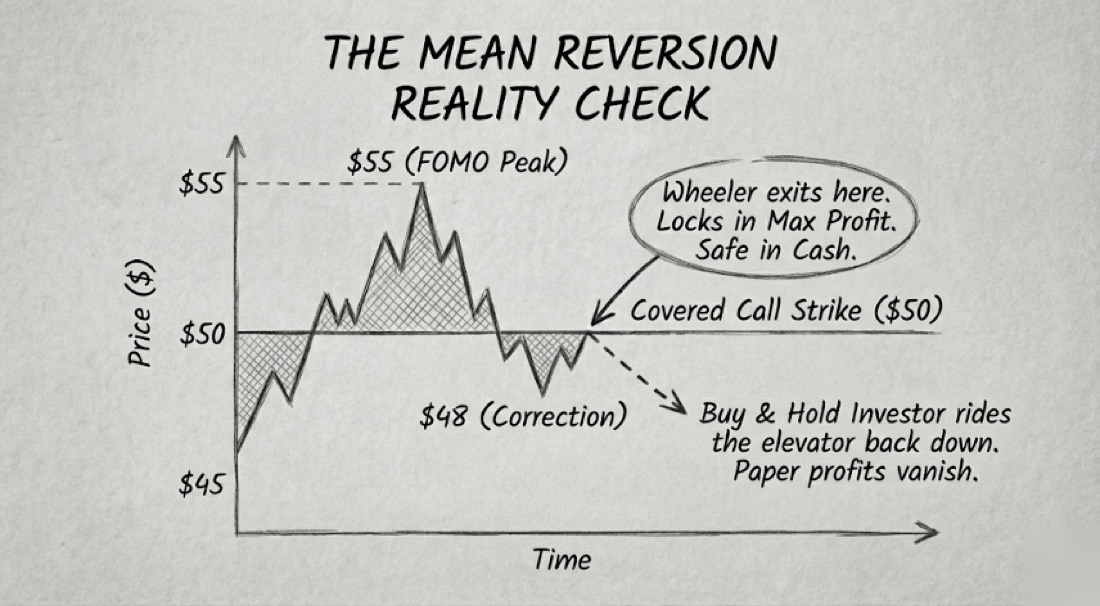
Look at where the exit lands. You are being called away at the point where the stock looks strongest and the story sounds best — the moment when selling feels most like a mistake.
That is not a coincidence. Being called away requires a rally, so by definition it happens when the tape is euphoric. You will never be assigned on a covered call during a quiet week when it would feel fine.
The discomfort is structural. It arrives every single time the trade works.
Where this comes from
Question 32 of Wheel of Time Decay: Option Wheel Decoded, which spends its final section on the psychology — FOMO, panic, and the moments when the correct action feels worst.
“Of all the kindle unlimited books on the wheel strategy, and believe me when I say I have read almost all of them. This one is by far the best. Don’t overlook this gem!”— Amazon reader review, ★★★★★
Wheel of Time Decay on Amazon →
What chasing it costs
The reflex is to roll up and out: buy back the call, sell a higher strike further out, stay in the stock.
Price that honestly. Your short call has gained value because the stock rallied, so buying it back is a real debit paid today. You are spending certain money to buy an uncertain continuation of a move that has already happened. And you are converting a closed, realised profit into an open directional position — on a stock that is now more expensive than when you judged it attractive.
Sometimes rolling is right. It is right when the thesis genuinely changed, not when the screen is green and you feel behind.
The reframe that holds up
You are not in the business of catching every move. You are in the business of being paid to accept a defined outcome, repeatedly, and living to do it again next month.
A stock that rockets past your strike gave you the best version of your own trade. The version where it drifts sideways pays less. The version where it falls hands you shares.
Of the three, the one that stings is the one that paid most.
What to do instead
Restart the cycle deliberately. The capital is free, so ask the entry question again from scratch: is this still a stock you would happily hold for years, and does the current premium justify locking up the collateral?
Sometimes the answer is the same ticker at a higher strike. Sometimes the rally means the premium no longer compensates you and the money belongs elsewhere. Both are fine. What is not fine is re-entering automatically because you want the stock back.
Keep reading
- Why assignment is not a loss
- Dividend risk and early assignment
- When to roll an option, and when not to
OptionsLabPro is a structured options course built on interactive lessons — cap the upside on a payoff curve and watch what a rally does to it.