

 Arda Zuber, PhD
Two questions about dividends and covered calls get asked constantly, and they have opposite answers. The first is reassuring. The second is the one that surprises people on a Wednesday morning.
Yes, the dividend is yours
Sell a covered call and you remain the shareholder. Own the shares before the ex-dividend date and the full payout is yours, regardless of the call you sold against them.
That gives an assigned wheel position two income streams running at once: the call premium and the dividend. On a stable dividend payer it adds a meaningful 1-3% a year on top of the premium, and it is one of the quiet reasons assignment on a quality name is not the disaster it feels like.
So far, good news.
And then the email arrives
You own a stock at $55. You sold a $50 call, two weeks to expiration, comfortably profitable. The ex-dividend date approaches and the $0.50 per share is about to be yours.
Wednesday morning: early assignment notice. Your shares are gone. Someone exercised your call the night before the ex-date and collected the dividend you were counting on.
Where this comes from
Questions 30 and 31 of Wheel of Time Decay: Option Wheel Decoded, which handle dividend rights and dividend risk as a pair because they are two sides of the same date.
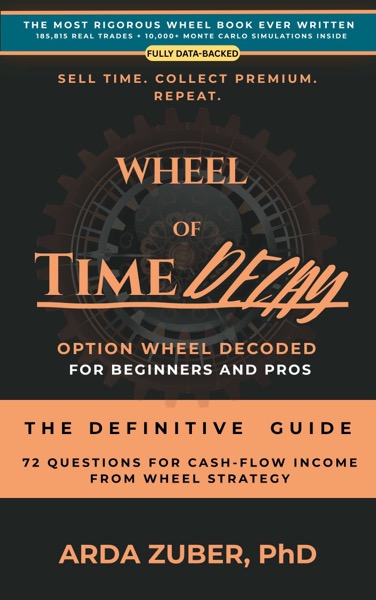
“Of all the kindle unlimited books on the wheel strategy, and believe me when I say I have read almost all of them. This one is by far the best. Don’t overlook this gem!”— Amazon reader review, ★★★★★
Wheel of Time Decay on Amazon →
Why it happens — and why it is not personal
An option holder who exercises early gives up the remaining time value of the option. In exchange, they own the shares — and therefore the dividend.
So the whole thing reduces to one comparison:
Is the remaining extrinsic value less than the dividend?
If yes, exercising is worth more than holding. Anyone running the numbers will do it, and many are running the numbers automatically.
The danger zone, drawn
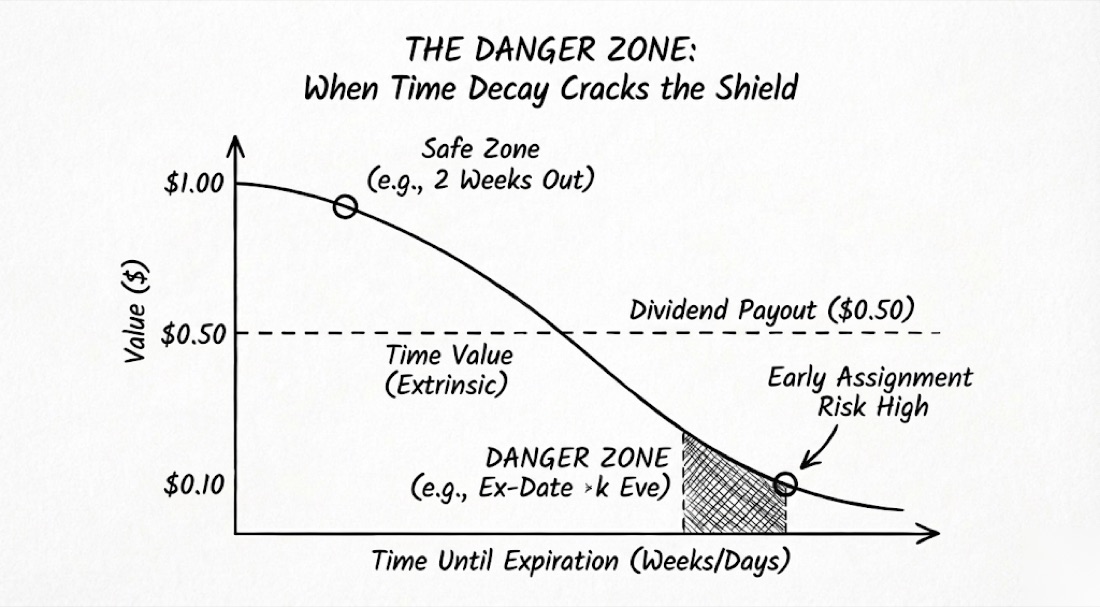
The curve is the extrinsic value of your short call. The dashed line is the dividend.
Two weeks out, time value sits at $1.00 against a $0.50 dividend. Nobody exercises — they would be throwing away fifty cents. Safe.
The eve of the ex-date, time value has decayed to $0.10. Now exercising captures $0.50 and forfeits $0.10. That is a free forty cents, and the shaded region is where it becomes obvious to everyone holding your call.
The risk is not gradual. It concentrates on one night, and the crossing point is where the curve passes under the line.
What to actually do
Know the ex-dividend dates for everything you hold. Not approximately — the calendar is the entire early warning system, and it is published.
Before each one, check two numbers: how deep in the money the call is, and how much extrinsic value remains. If extrinsic is below the dividend, you are in the zone.
Then choose deliberately:
- Roll out to a later expiration. More time means more extrinsic value, which restores the shield.
- Accept it. If being called away at that strike was fine anyway, early assignment just moves it forward. You keep the premium and the capital gain, you miss the dividend.
The failure mode is not choosing wrong. It is being surprised — losing the shares, the dividend and the plan on a date that was on a public calendar the whole time.
The pattern
Early assignment is not random and it is not aimed at you. It is arithmetic that becomes favourable to someone else, at a moment you can calculate in advance.
Which means it is one of the few risks in options that is genuinely avoidable by looking things up.
Keep reading
- Having your shares called away is the win
- When to roll an option, and when not to
- Why assignment is not a loss
OptionsLabPro is a structured options course built on interactive lessons — watch extrinsic value drain out of a call instead of reading that it does.