

 Arda Zuber, PhD
This is the least interesting decision in the wheel and one of the few you genuinely cannot fix afterwards.
How you end up with three cost bases
Run the strategy on one name for a while and multiple lots appear without anyone intending it:
- Month 1 — assigned 100 shares at $50
- Month 2 — assigned 100 more at $45
- Month 3 — assigned another 100 at $40
Three hundred shares of the same company at three different prices. Nothing unusual happened; this is what selling puts into a decline produces.
Now the stock recovers to $48 and your covered call is exercised. The broker sells 100 shares at $48.
Which 100?
The default answers for you
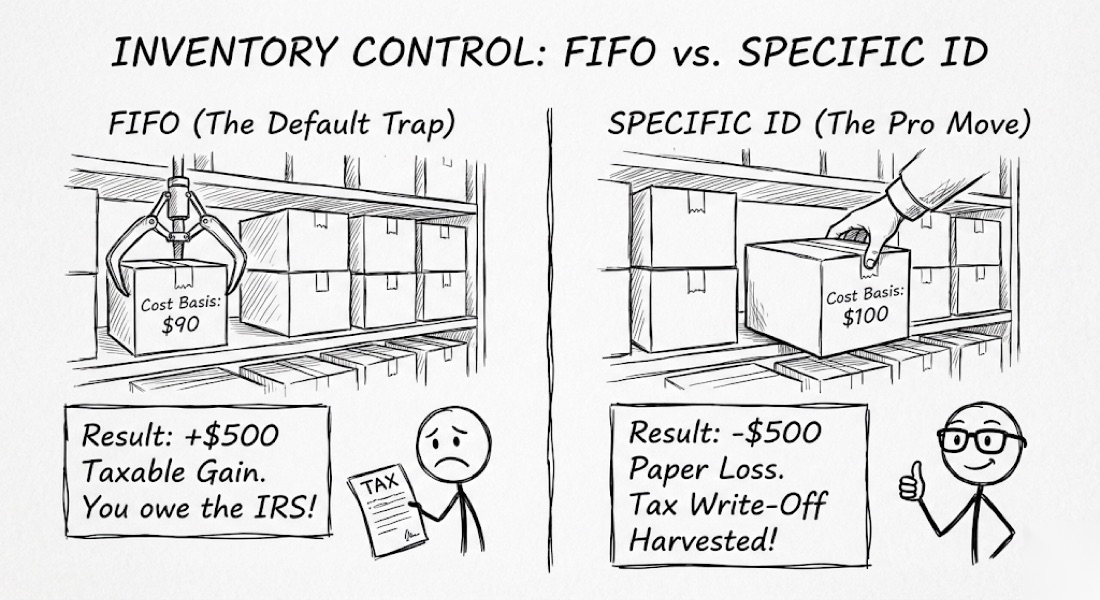
Most brokers default to FIFO — first in, first out. The oldest lot goes first, automatically, without asking.
So the $50 shares are sold at $48. That is a $2 per share loss, and it is the lot you would most likely have wanted to use — a realised loss is deductible, and disposing of your highest-cost shares first is usually the sensible order.
Under Specific ID, you choose. Sell the $40 lot and you book an $8 gain now. Sell the $50 lot and you book a $2 loss. Same shares, same sale price, entirely different tax outcome — and over years of assignments, the difference compounds into a number that matters.
FIFO is not wrong. It simply makes the decision for you, in the same order every time, without reference to what would suit you.
Where this comes from
Question 24 of Wheel of Time Decay: Option Wheel Decoded, which handles the mechanics around assignment — cost basis, break-even, tax lots and what your broker's P&L is actually showing you.
“Of all the kindle unlimited books on the wheel strategy, and believe me when I say I have read almost all of them. This one is by far the best. Don’t overlook this gem!”— Amazon reader review, ★★★★★
Wheel of Time Decay on Amazon →
Why it is specifically a wheel problem
Most investors accumulate a position once and sell it once. One lot, no decision.
The wheel manufactures lots. Every assignment at a different price creates one, and the strategy is designed to get assigned repeatedly on the way down. Then covered calls dispose of shares at yet another price. Multiple acquisitions, multiple disposals, all in one ticker.
That is exactly the situation where lot selection stops being an accounting detail.
The part that makes it urgent
You generally cannot retroactively change the method for sales that have already settled.
Which means this is not a thing to optimise later when the account is larger and the stakes are higher. By then the trades that would have benefited are closed, matched under FIFO, and reported.
Set it before the first assignment. It costs five minutes in your broker's cost basis or tax lot preferences, and it is the rare decision where doing it early is the entire value.
The honest scope
I am a trader, not an accountant, and tax rules differ by country and change. What is general is the mechanism: when you hold several lots, something decides which one gets sold, and you can either make that decision or inherit it.
Choosing to inherit it is a decision too. It is just one most people make by not opening the settings page.
Keep reading
- Short-term gains and the wash sale rule
- Why assignment is not a loss
- Having your shares called away is the win
OptionsLabPro is a structured options course built on interactive lessons.