

 Arda Zuber, PhD
The wheel has an opponent nobody mentions in the strategy guides, and it takes a larger cut than the market does in most years.
A note before anything else: I am a trader, not an accountant. What follows is an overview of US federal rules, they change, and they differ by country. Treat it as orientation and take the actual decisions with a qualified professional.
Two buckets, very different rates

Long-term. Hold more than a year and profit is taxed at long-term capital gains rates — 0%, 15% or 20% depending on income.
Short-term. Close inside a year and profit is taxed as ordinary income, up to 37% federal at the top bracket.
The wheel lives entirely in the second bucket. Positions open and close on a 30-45 day cycle. Almost nothing you do reaches the holding period that would qualify for the lower rate.
What that does to the headline number
Take a concrete case. You earn $100,000 at your job and make $20,000 from the wheel. The IRS sees $120,000, and the wheel profit is taxed at your marginal rate — say 32%.
Your 20% gross return becomes roughly 10-12% net.
That is not a rounding error. For most premium sellers it is the entire margin of safety, and it disappears in a line on a form in March, months after every trading decision that produced it has already been made.
Where this comes from
Question 68 of Wheel of Time Decay: Option Wheel Decoded, which spends its final section on the operational reality of running the strategy — routine, journaling, broker choice, and the tax code.
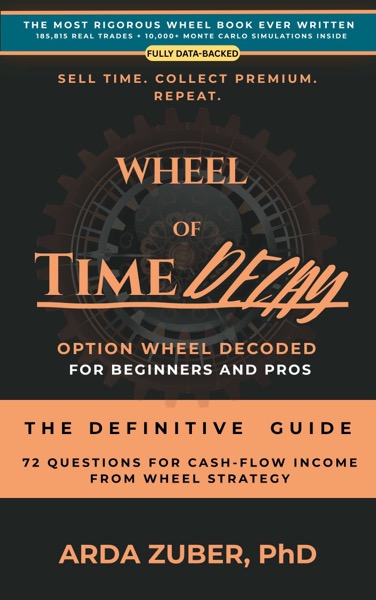
“Of all the kindle unlimited books on the wheel strategy, and believe me when I say I have read almost all of them. This one is by far the best. Don’t overlook this gem!”— Amazon reader review, ★★★★★
Wheel of Time Decay on Amazon →
The wash sale rule, and why the wheel walks into it
The rule: sell at a loss, buy something substantially identical within 30 days before or after, and the loss is disallowed for that year. It is not erased — it is added to the cost basis of the replacement position, deferred rather than lost.
Now look at what the wheel does. You sell a put on a ticker. It goes against you. You close at a loss and — because you still like the company and it is now cheaper — you sell another put on the same ticker next week.
That is the pattern the rule describes. The wheel does not stumble into wash sales occasionally; its core loop is the shape the rule was written to catch.
The consequence compounds in a specific way: losses recycle forward, your realised P&L and your taxable P&L drift apart, and by December the number your broker shows you and the number your accountant works from are two different numbers.
What actually helps
Structural, in order of impact:
- Tax-advantaged accounts. Where the wheel is permitted inside one, the entire problem changes shape. This is the single largest lever available.
- Specific ID over FIFO. Set lot selection before you start — it determines which shares you are deemed to sell, and you cannot retrofit it after the fact.
- Deliberate loss realisation. Know where your losses are before year end rather than discovering in March that they were washed.
Behavioural:
- Track after-tax return, not gross. They rank trades differently. A strategy that looks like it clears your hurdle at 20% may not clear it at 11%, and that is the number you actually keep.
The point
Not tax avoidance — tax awareness.
Every serious discussion of the wheel argues about strike selection and DTE, which move returns by a few percentage points. The tax treatment moves them by half. It deserves at least the same attention, and it gets almost none because it arrives once a year with no ticker symbol attached.
Keep reading
OptionsLabPro is a structured options course built on interactive lessons.