

 Arda Zuber, PhD
There is a rule in premium selling that costs nothing to follow, requires no new tool or indicator, and most sellers still get backwards: sell puts into red days, and sell calls into green days.
The reason is not superstition about market direction. It is that you are not being paid for the strike you chose. You are being paid for fear — and fear is priced differently on Tuesday than it was on Monday.
The same strike, two different prices
Take a stock trading at $100 and a $90 put you want to sell.
On a green day, the stock rises to $102. The market relaxes. That $90 put now sits further from danger, so it costs less — say $0.80.
On a red day, the stock slips to $98. Nothing about the company changed. But the market's willingness to pay for protection did, and implied volatility rose with it. Now you can sell the $85 strike — five dollars further from the price — and still collect $1.20.
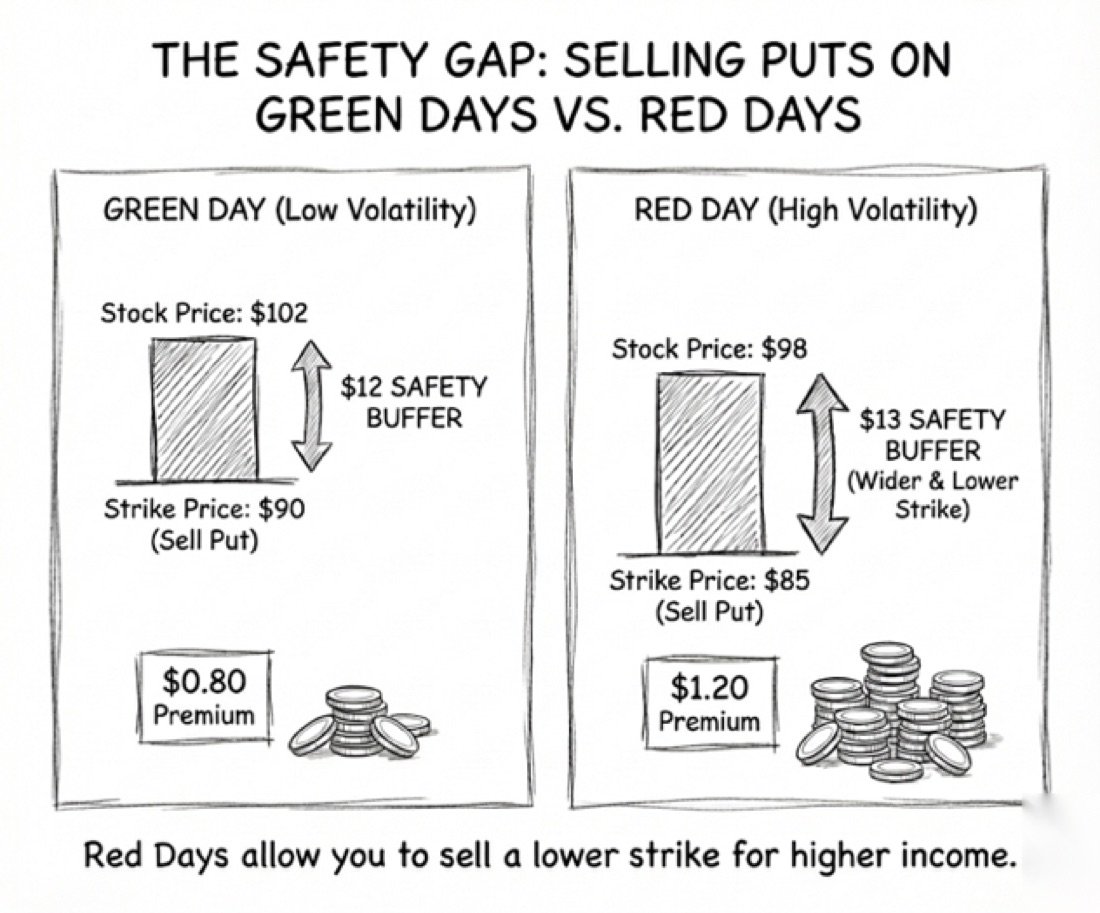
That is the whole trade in one picture. On the red day you take more money for a strike that is further away. You improved both sides of the deal by waiting one session.
Why the market pays you more for the same risk
Option premium is not a fee for the strike. It is compensation for perceived risk, and perception moves faster than fundamentals.
When prices fall, three things happen at once: implied volatility rises, put buyers get more anxious, and market makers widen what they will pay for downside protection. All three inflate the premium on the exact contract you were already going to sell.
The company did not become more dangerous overnight. The market simply became more willing to pay you to take the risk you had already decided to accept.
Where this comes from
This is Question 16 of Wheel of Time Decay: Option Wheel Decoded, which works through the option wheel as one repeating cycle across 72 questions — strike selection, timing, assignment, cost basis, rolling, and the parts that most treatments compress into a paragraph.
“Of all the kindle unlimited books on the wheel strategy, and believe me when I say I have read almost all of them. This one is by far the best. Don’t overlook this gem!”— Amazon reader review, ★★★★★
Wheel of Time Decay on Amazon →
What it looks like over time
A single trade's difference is small — forty cents on the example above. The point is that it repeats.
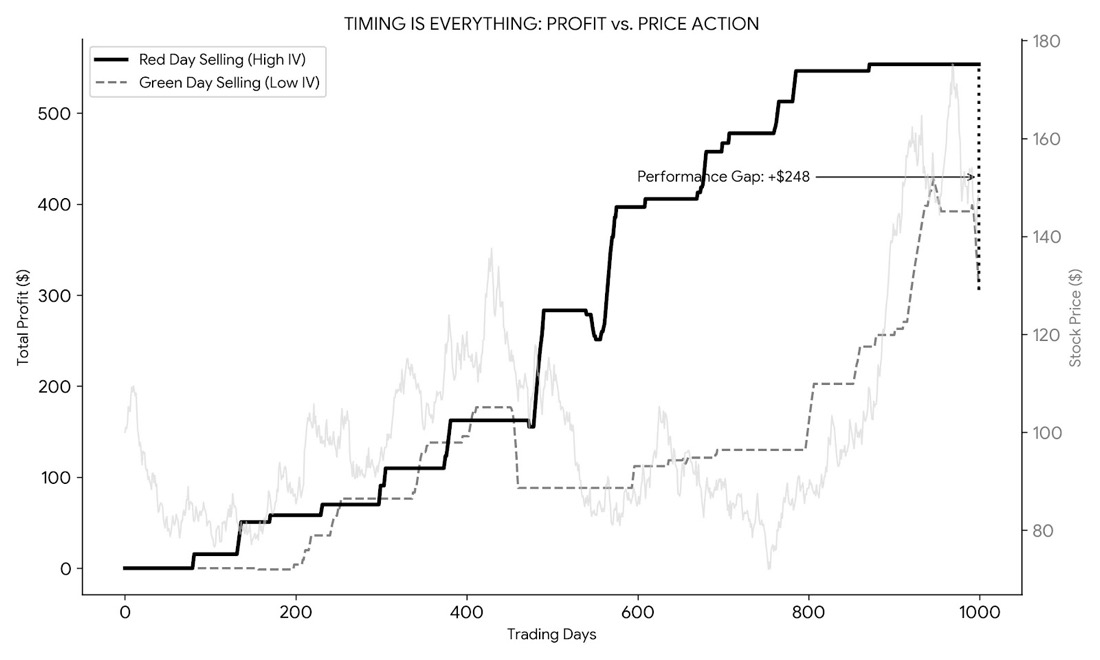
Across 1,000 trading days of the same strategy on the same underlying, the only variable being which day you chose to enter, the gap compounds. The chart above is from Wheel of Time Decay, and the separation between the two lines is the accumulated cost of entering when it felt comfortable.
Note the shape: the red-day line does not win by being smoother. It wins by being paid better each time it enters.
The part that is actually hard
None of this is complicated. It is hard for a different reason.
A red day is when selling a put feels worst. The screen is red, the position you are about to open is on something falling, and every instinct says wait for stability. A green day is when it feels best — and that is exactly when you are paid least.
The discipline is not analytical. It is the willingness to act when the action is uncomfortable, on the grounds that the discomfort is precisely what you are being paid for.
The mirror rule
The same logic runs in reverse for the other half of the wheel. Covered calls belong on green days. When a stock rallies, greed inflates call premiums the way fear inflates puts. If you own shares and you are going to sell a call against them, the rally is your moment — not the pullback.
Put simply: sell into the emotion, not away from it.
Keep reading
Reading about implied volatility inflating a premium and watching it happen to a chain you are looking at are different experiences. OptionsLabPro is a structured options course where the lessons are interactive — you move the inputs and watch the chain and the payoff curve respond.