

 Arda Zuber, PhD
There is a sentence worth putting above every options screener, and it costs people more than any strategy mistake:
Entry is optional. Exit is mandatory.
You choose whether to open a position. You do not, ultimately, choose whether to close one — expiration decides that if you do not. And the price you pay to get out is set by a number most sellers glance at once and never think about again.
You make money on the buy, not the sell
The credit hitting your account on entry is not profit. It is a liability priced at the market.
The trade resolves when you buy the contract back or it expires. Everything between those two points is unrealised, and the exit price is where the money is actually decided.
Which makes the spread you will pay on the way out a real cost of the trade — one you can measure before you enter, and one most people do not.
The same trade on two chains
Liquid — SPY. Mid $2.00, bid $1.99, ask $2.01. You close at the offer and pay $0.01.
Illiquid — a small cap. Mid also $2.00. Bid $1.60, ask $2.40. You close at the offer and pay $0.40.
Same nominal position. Same mid price. One exit costs a penny, the other costs 20% of the contract's value, handed to the market maker for the service of letting you leave.
Where this comes from
Wisdom 4 of Live to Sell Another Day: The Seller's Code — twenty-five rules distilled from real losses, organised around risk rather than a catalogue of strategies.
Live to Sell Another Day on Amazon →
It scales in a straight line
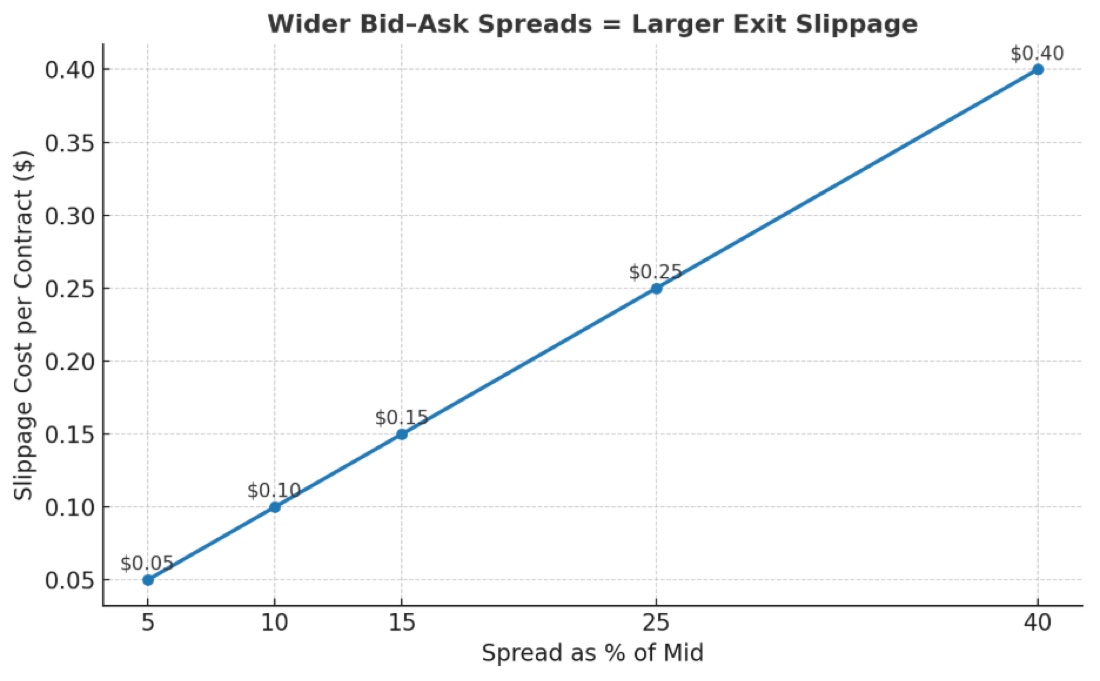
Slippage rises linearly with the spread — $0.05, $0.10, $0.15, $0.25, $0.40 per contract as the spread widens from 5% to 40% of mid.
There is no threshold effect and no point where it stops mattering. It is a straight tax on expectancy, charged every time you close, and it does not care whether the trade was a winner.
For a strategy built on repeatedly closing positions at 50% profit, that tax is levied on every single cycle.
Why the trap is baited
The chains with the widest spreads are frequently the ones paying the richest premiums, and for the same underlying reason: nobody else wants to trade them.
So the screener that surfaces "unusually high credit" is often surfacing "unusually hard to exit." You collect the extra premium at entry and quietly refund a chunk of it at exit — and because the refund happens weeks later, on a different screen, most people never connect the two.
The book's name for this is a roach motel: easy to get into, hard to get out of.
What to check, before you enter
Open interest. Above roughly 500 on your target strike is a reasonable floor. Above 100 is workable if every surrounding strike is also above 100 — a chain that is thin everywhere behaves differently from one thin spot.
Spread as a percentage of mid. A few percent is fine. Approaching 20-25% means the exit is compromised before the trade has done anything.
Whether you can name the other side. If you cannot imagine who would take the other side of your close at a fair price, that is the answer.
The principle underneath
A theoretical profit you cannot exit at a fair price is not a profit. It is a position, and positions have to be closed by somebody at some price.
Liquidity is not a comfort or a preference. It is the thing that converts a good trade into money.
Keep reading
OptionsLabPro is a structured options course built on interactive lessons.