

 Arda Zuber, PhD
At some point every wheeler asks whether to keep picking stocks or just run the index. The answer is less about skill than most discussions assume.
What an index cannot do to you
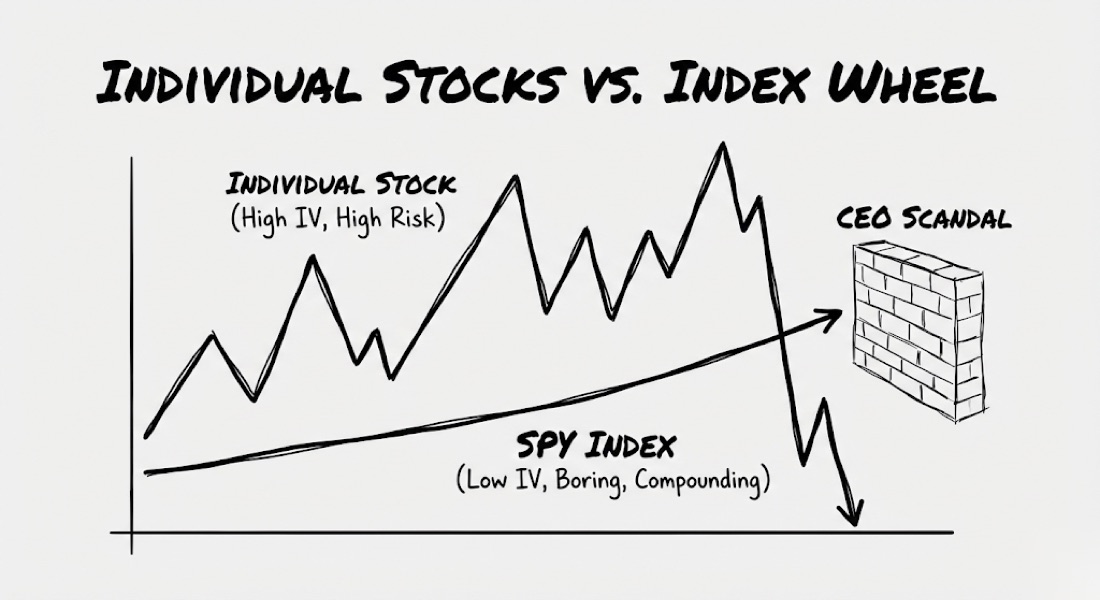
The picture is the argument, and the wall on the right is the point.
The single stock is the jagged line — high implied volatility, richer premiums, more to work with. Then a company-specific event arrives and the line goes through the floor while the rest of the market is unaffected.
That is idiosyncratic risk: the danger from something specific to one company. Fraud. A failed product. A CEO leaving under a cloud. A regulator. Nothing about the economy changed; your position changed.
The index line is the boring one. It compounds slowly, pays thin premiums, and cannot have a CEO scandal. A weighted average of hundreds of companies has no CEO to lose.
Why this is dangerous specifically for the wheel
The wheel's repair mechanism assumes recovery. Assigned above the market, you sell calls, grind the cost basis down and wait for the stock to come back.
Company-specific damage is the case where that assumption can fail. The market recovers, your sector recovers, and your name does not — because what broke was the business, not the price.
Then you are in the bag-holding cycle: selling calls that generate a trickle of premium against a position that will not bounce, capital locked, cost basis descending far too slowly to matter. The strategy has not blown up. It has simply stopped working, on one name, for a long time.
Where this comes from
Question 57 of Wheel of Time Decay: Option Wheel Decoded, in the section on variations — the index wheel, the poor man's wheel, synthetic equity and the ratio wheel.
“Of all the kindle unlimited books on the wheel strategy, and believe me when I say I have read almost all of them. This one is by far the best. Don’t overlook this gem!”— Amazon reader review, ★★★★★
Wheel of Time Decay on Amazon →
What the index costs you
Two things, and both are real.
Thinner premiums. An index averages away company-specific moves, so realised volatility is structurally lower, so implied volatility is lower, so the credit is smaller. You are paid less because you are taking less risk — the pricing is behaving correctly.
More capital per contract. SPY at index level means each cash-secured put ties up a large multiple of what a mid-price stock requires. A small account simply cannot run it, which is the practical reason most people start with single names whatever they would prefer.
How to actually decide
Not by preference. By account size and by what a single bad name would do to you.
Small account. Individual stocks, because the index is unaffordable. Accept the idiosyncratic risk and manage it with the tools that exist for it — position limits, quality filters, avoiding binary events.
Growing account. A mix, with the index share rising as the account grows.
Large account. The index becomes attractive not because returns improve, but because a single company event stops being able to matter. That is what you are buying with the lower yield.
The book puts the transition well: the index wheel is not about getting rich faster, it is about staying rich longer.
The honest summary
You are choosing which risk to hold, not whether to hold risk.
Single names pay you to accept that one company can ruin a quarter. The index pays less and removes that possibility entirely. Neither is correct in the abstract — but the right answer changes as the account grows, and most people notice the change later than they should.
Keep reading
OptionsLabPro is a structured options course built on interactive lessons.