

 Arda Zuber, PhD
The wheel has a capital problem that nobody solves by being cleverer about strike selection. To run it on a mega-cap you need the cash to own 100 shares, and on a $210 stock that is $21,000 sitting locked for a $200 monthly premium.
The poor man's covered call is the structural answer, and it comes with a cost that is usually undersold.
The swap
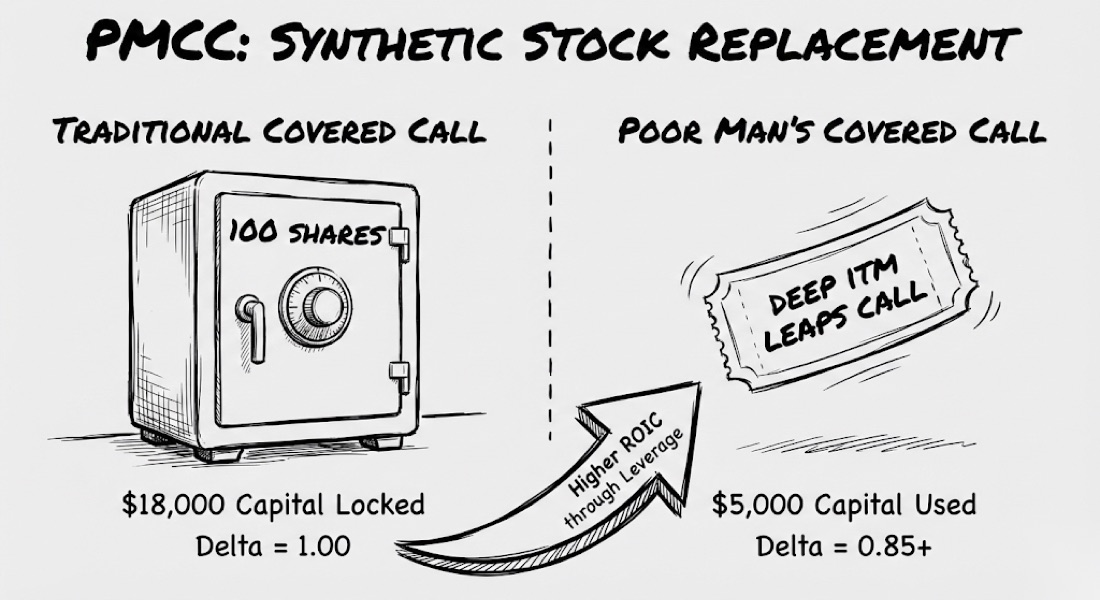
Replace the 100 shares with a deep in-the-money LEAPS call — 0.80+ delta, 12-18 months out — and sell short-dated calls against it exactly as you would against stock.
The picture states the trade plainly: $18,000 locked at delta 1.00 becomes roughly $5,000 at delta 0.85. Same directional exposure, a quarter of the capital.
A 0.90 delta LEAPS effectively owns 90 shares' worth of movement. The stock rises $10, the option gains about $9. That is what makes the substitution work at all.
Why 0.80 delta and not 0.95
Because a 0.95 delta call is nearly the shares, and priced accordingly. You would be paying almost full price for the thing you were trying not to pay for.
Around 0.80 the option still tracks the stock closely enough to function as stock replacement while preserving the capital saving that is the entire reason for the structure. Go much lower and the tracking loosens — the position stops behaving like shares and starts behaving like a directional bet, which is a different trade with different failure modes.
Where this comes from
Question 56 of Wheel of Time Decay: Option Wheel Decoded, in the section on variations — the poor man's wheel, the index wheel, synthetic equity and the ratio wheel.
“Of all the kindle unlimited books on the wheel strategy, and believe me when I say I have read almost all of them. This one is by far the best. Don’t overlook this gem!”— Amazon reader review, ★★★★★
Wheel of Time Decay on Amazon →
Why 12-18 months
The long expiration is not conservatism, it is mechanics. You need runway to sell short calls repeatedly, and you need the LEAPS decaying slowly while the short calls decay quickly.
That gap is the engine. Long-dated options lose value slowly; short-dated ones lose it fast. You are structurally long the slow decay and short the fast decay, and the monthly premiums offset the LEAPS' own theta.
Buy a six-month call instead and you invert it — now your long leg is decaying at a rate the short premiums cannot cover.
The cost, stated honestly
The long leg expires. Shares do not.
This is the whole trade-off and it deserves more than a footnote. If you own 100 shares and the stock falls 30%, the position is unpleasant but patient — you keep selling calls, you keep collecting dividends, and you can wait years for the thesis to work.
If you own a LEAPS and the stock falls 30% and sits there, you have a clock. The option decays toward worthlessness on a schedule that does not care whether you were eventually right.
So the PMCC does not simply make the wheel cheaper. It converts a strategy that can wait indefinitely into one that must be right within a timeframe. You have exchanged patience for leverage.
That exchange is often worth making. It should be made knowingly, and it is a poor fit for exactly the situation the wheel handles best — a quality company having a bad eighteen months.
Who it actually suits
Someone with genuine conviction on a mega-cap, a defined view on when it plays out, and not enough capital to own it outright.
It suits far less well as a way to run more positions than your account can support. The capital saving is real, and the temptation is to treat it as free size. It is not free; it is borrowed against an expiration date.
Keep reading
- Wheeling an index versus single stocks
- Having your shares called away is the win
- How margin removes the wheel's only edge
OptionsLabPro is a structured options course where the lessons are interactive — build a diagonal and watch what the two expirations do to each other.