

 Arda Zuber, PhD
The wheel is not a clever strategy. Its edge is structural and almost embarrassingly simple: you can wait.
A quality company drops 30% on bad earnings. You take assignment, you sell covered calls against the shares, you collect dividends, and you wait for the recovery on whatever timeline it needs. Nobody can make you sell.
That is the whole machine. Margin removes it.
Ownership versus rental
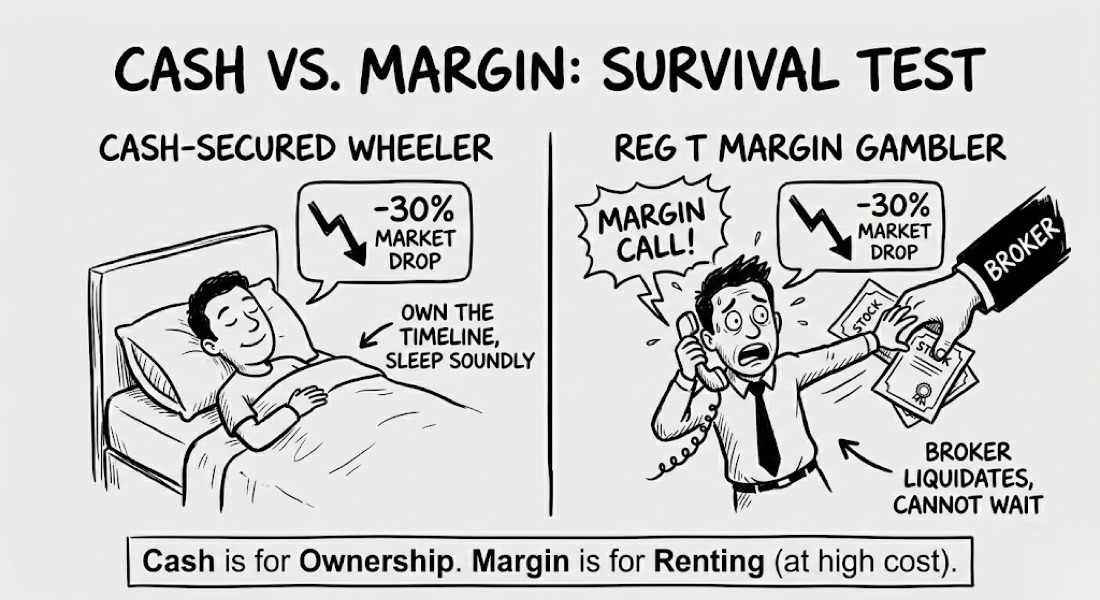
Cash-secured. You promised to buy the stock with your own money. Assigned, you own the shares outright. Down 50%, you wait. Your timeline belongs to you.
On margin. You promised to buy the stock with borrowed money. Assigned, you own shares bought with a loan. Your timeline belongs to whoever made the loan.
The caption states it plainly: cash is for ownership, margin is for renting — at high cost.
Why the broker cannot wait
This is the part worth sitting with, because it is not a matter of the broker being unreasonable.
Your broker has no view on your five-year thesis and no obligation to it. They have a loan secured by collateral, and when the collateral falls in value they need the loan covered. That is the entire relationship.
So when the position moves against you, the broker liquidates — at the time it chooses, not the time you would choose. Which means selling into a falling market at prices you would never accept voluntarily.
A drawdown that a cash seller sits through becomes a realised loss for a margin seller. Same stock, same entry, same thesis. Different owner of the clock.
Where this comes from
Question 49 of Wheel of Time Decay: Option Wheel Decoded, in the section on risk — stock selection, sizing, correlation, and the ways a working strategy stops working.
“Of all the kindle unlimited books on the wheel strategy, and believe me when I say I have read almost all of them. This one is by far the best. Don’t overlook this gem!”— Amazon reader review, ★★★★★
Wheel of Time Decay on Amazon →
The number on your screen is not yours
Margin makes this hard to resist because the platform shows you a buying power figure roughly twice your cash, and the arithmetic that follows is seductive: twice the puts, twice the premium, same account.
What that number actually reports is how much the broker will let you borrow. It says nothing about how much you can afford, and the two only diverge when it matters.
Sell twice as many cash-secured puts as you can fund and you have not doubled your income. You have written obligations you cannot meet if they are all assigned — which, because correlations converge in a sell-off, is roughly when they will be.
The cruel timing
Maintenance requirements are not constant. Brokers raise them during volatility events.
So the sequence, on the day it matters, runs like this: your positions move against you together, your margin requirement rises, your available capacity shrinks, and the call arrives — all from the same cause, all at once, at the bottom.
Margin does not merely add risk. It concentrates the risk at the worst possible moment, because every one of those mechanisms is triggered by the same event.
The rule
Use cash buying power only. Ignore the inflated figure.
If your account can fund three cash-secured puts, sell three. The broker will happily let you sell six, and the six will feel identical to the three for months — right up until the week they do not.
Keep reading
- Sizing for the loss rather than the win
- Why assignment is not a loss
- When to stop selling and hold cash
OptionsLabPro is a structured options course built on interactive lessons.